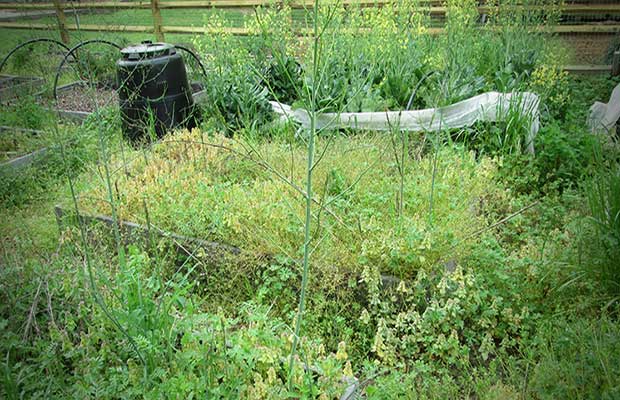
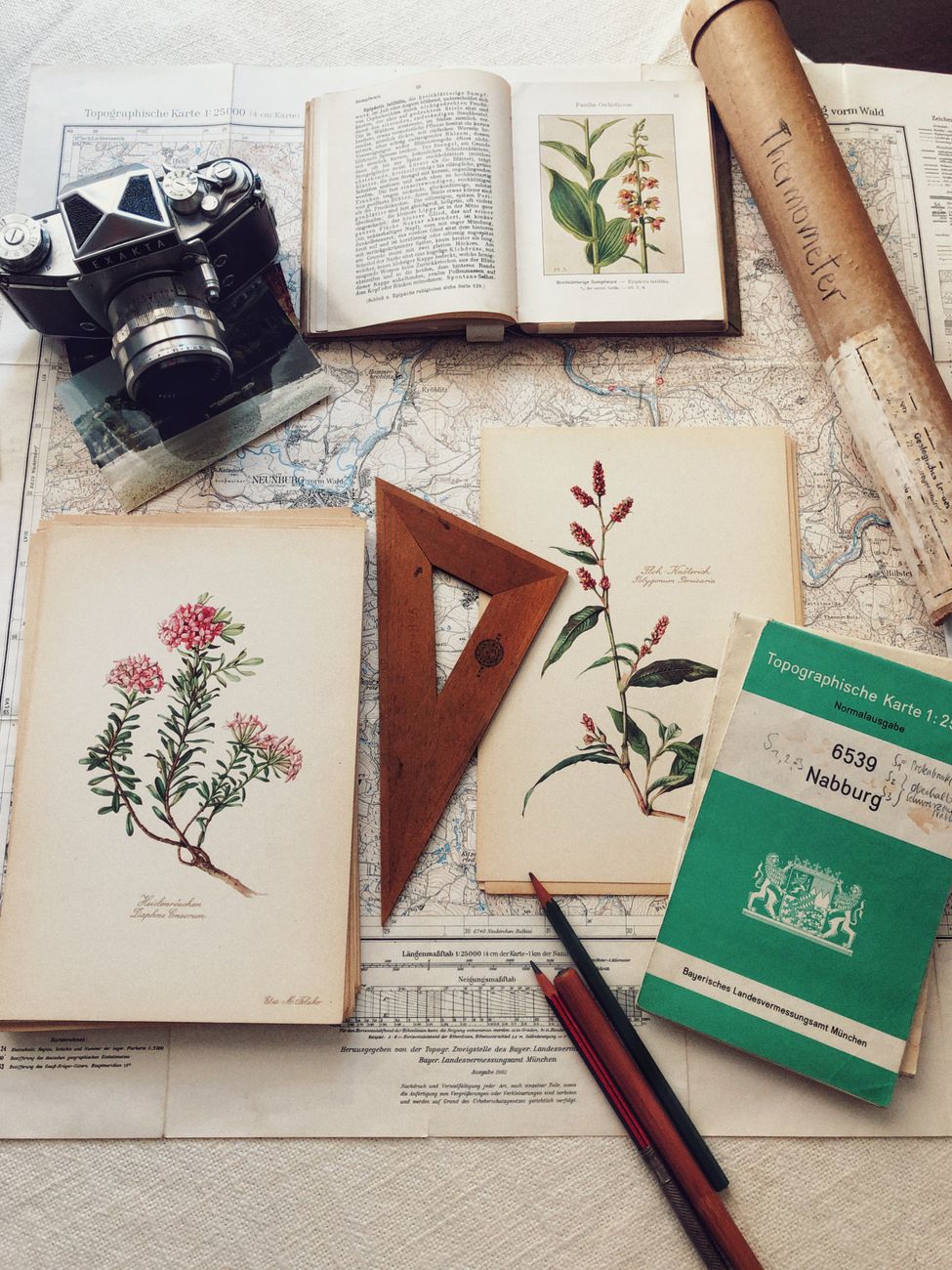
Well, the current garden experiment is coming to a close! With the growing season winding down, I have only tomatoes and peppers left in the garden.
Unfortunately, I got behind on my garden commonplace book and really should try to catch up before I forget everything I’ve learned along the way.
This year has definitely been an experiment. Some things worked, some things didn’t, and some things left me scratching my head. But that’s part of the fun, isn’t it?
One of the things I enjoy most about gardening is that there’s always something new to learn. Just when I think I’ve figured something out, a plant decides to do something completely unexpected. And of course, what works wonderfully one year might not work at all the next.
I had quite a few plans for the garden this year, and I certainly didn’t accomplish everything I wanted to. But I did learn a lot, and I think that’s worth something.
Now I need to sit down with my commonplace book and document what I can remember. What grew well? What struggled? What would I do differently? And perhaps most importantly, what do I want to try next time?
I suppose that’s one of the nice things about gardening. There’s always another growing season, another experiment, and another opportunity to figure things out.
For now, though, I think I’ll enjoy whatever the tomatoes and peppers have left to offer. And maybe actually catch up on that commonplace book. Hah!
Normally, I don’t post something the day I actually do it. But today, I was especially frustrated because I don’t feel like I’m making progress.
I bought some chipboard so I could try working with a more professional material. I’m still using printer paper for now, as I want to get this down before I start using my nice paper.
I made six signatures with five sheets of paper each. I wanted to make sure the stitching was visible, so I got out the waxed thread that came with my upholstery repair kit and threaded a bookbinding needle.
The waxed thread is very difficult to manage. I couldn’t keep tension, and I think it’s just too thick for bookbinding. I got to the third signature and realized I wouldn’t have enough thread for the other three, so I decided to just sew on the cover and call it good.
And of course…I was about 1/2″ short.
Then I got out some embroidery floss, which is too thick for the bookbinding needles. I was able to thread a curved needle, which seems like a great option for this type of binding. However, I haven’t worked with a curved needle before, and I kept dropping it.
I made sure I had plenty of thread this time. So obviously, it got tangled, and I had to start over for the fifth time. (I left out some retries because they’re really not important in the grand scheme of things.)
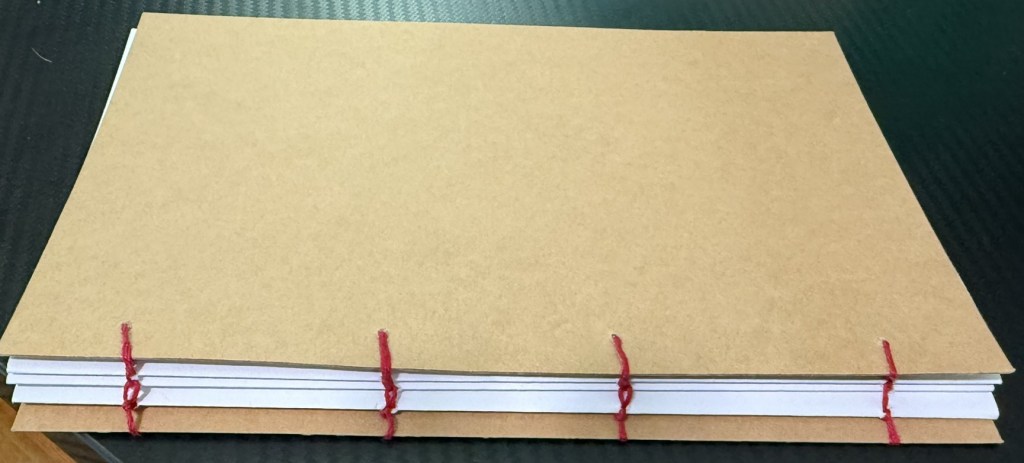
I finally got four signatures plus the cover secured. Yet even though I blamed the waxed thread for the tension issues, it was me all along.
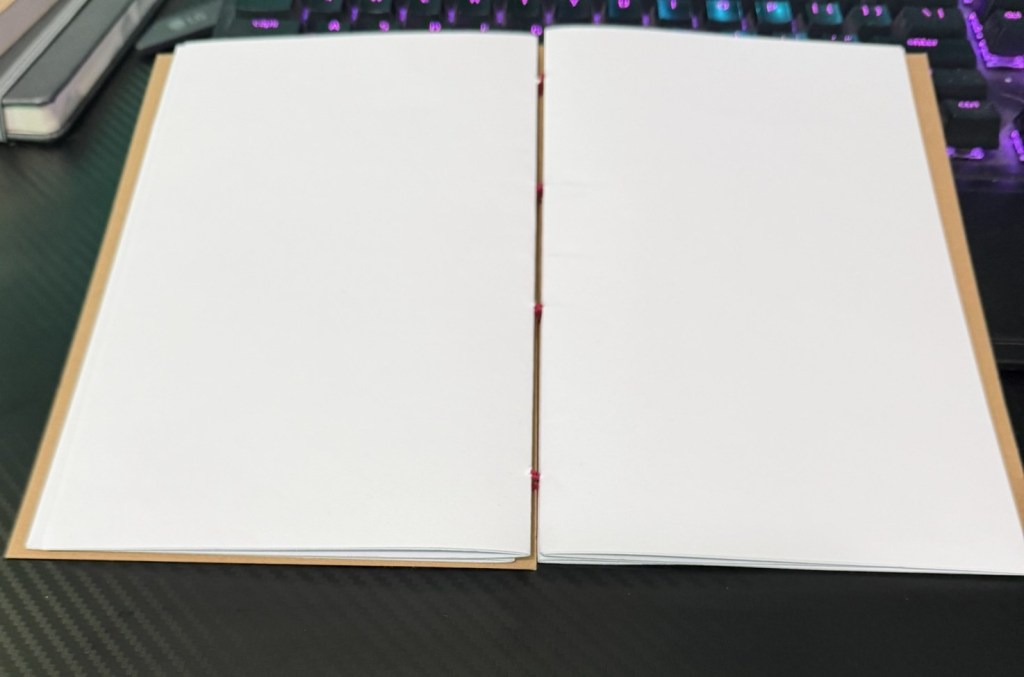
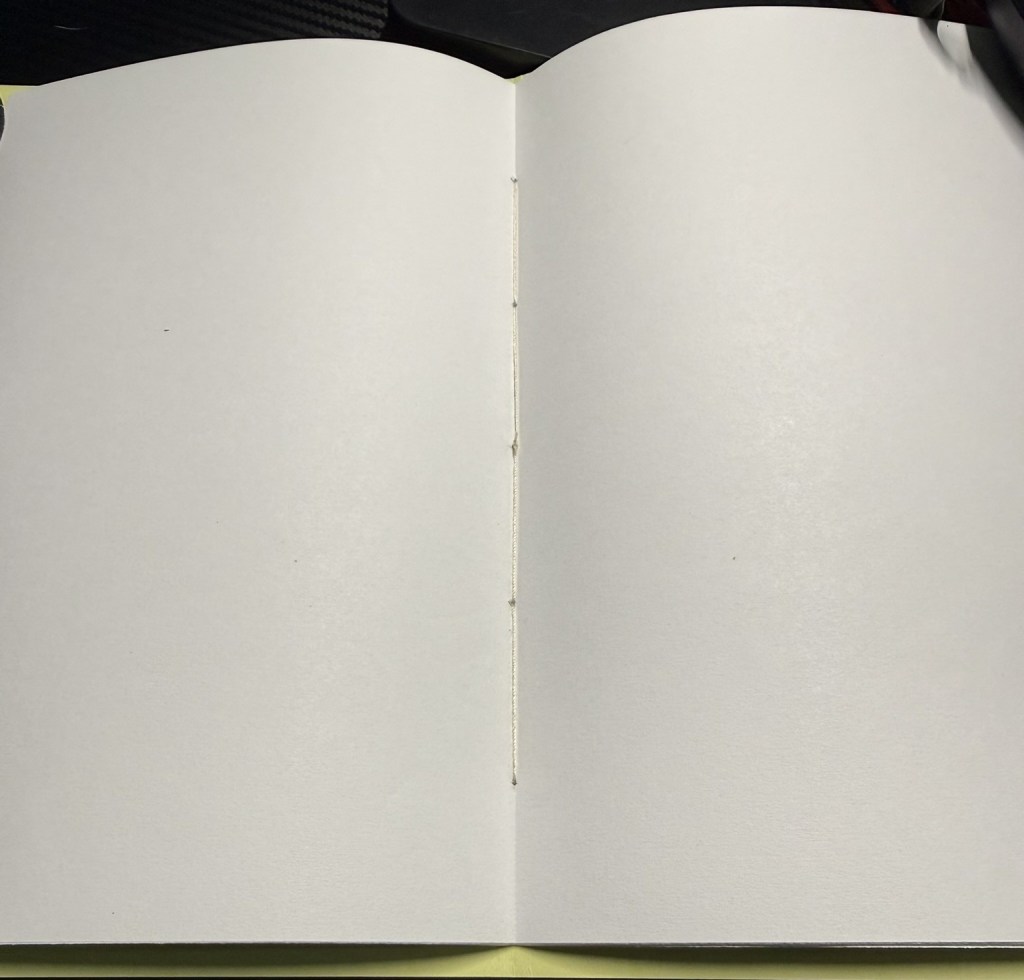
Thus, the cover lies flat, but only because the stitching is so loose.
I started this blog because I wanted to share the learning process, which includes days of frustration and failure. Though I suppose nothing is truly a failure if you manage to learn something along the way.
Maybe I’ll do a Tunisian crochet thing next…even though I know I have tension issues there, too!
I am obsessed with baseball. With one team in particular, but that’s not important right now.
One of my commonplace books is solely about baseball — some stats about my favorite players, pictures of their various World Series wins, and the best part: mapping out different pitch types, from what they look like from the batter’s box to what they look like from the side.
I grew up watching my dad play baseball, and honestly, I sure was sick of it for a while. Then, a couple of years ago, I happened to turn on the Friday night Apple TV game. Immediately, the noise of the crowd and the game itself calmed my nerves.
I had forgotten how soothing it was.
So I dove back in full throttle.
I love studying stats and trying to figure out what might happen based on current numbers. One of the things I like about the Apple TV broadcast is that they show cool stats like “probability of reaching base” and things like that.
Though if I were the batter, it probably wouldn’t feel great to see “probability of a strikeout: 60%.” Hah!
I dedicated an entire section of my 2026 planner to my team. I wrote out the schedule, where I keep track of wins and losses. I have a roster that I update when players are injured, sent down to AAA, called back up, etc.
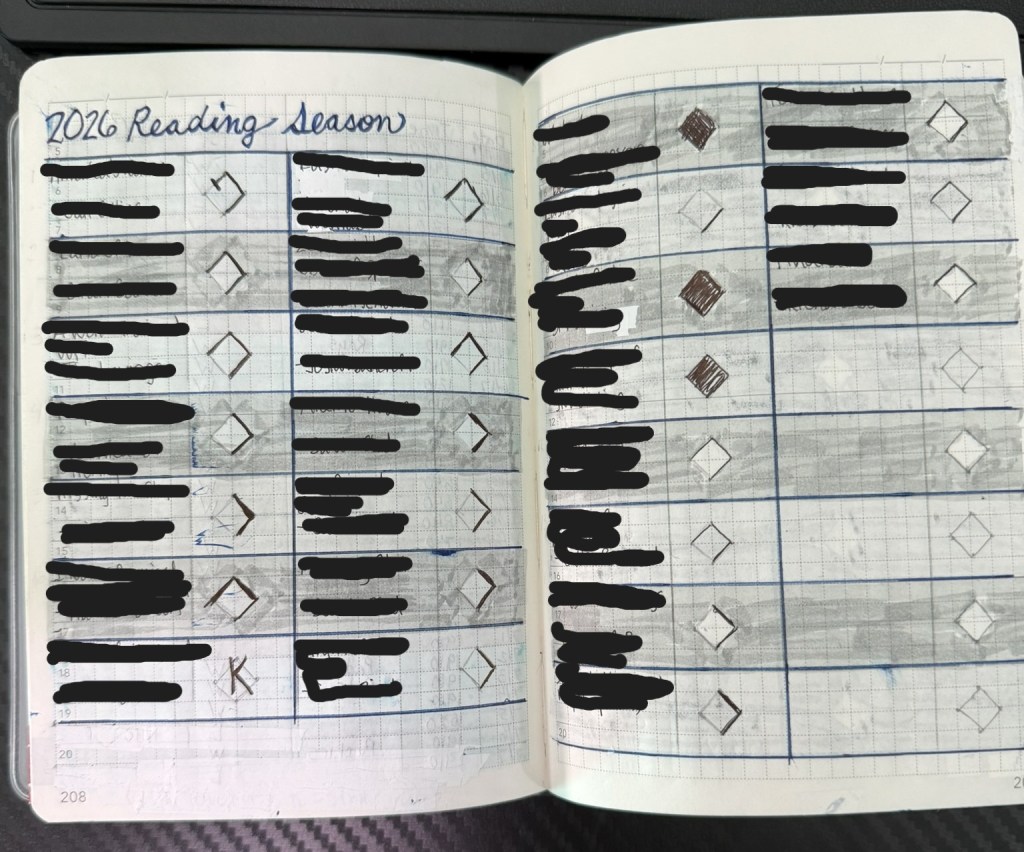
I even made a reading tracker that looks like a scorekeeper’s book: single = 1 star, double = 2 stars, and you can figure it out from there. I write a “K” — which signifies a strikeout — if I hated the book but finished it anyway.
I am sorry to say I have few home runs this year, but several strikeouts.
But that’s the game.
And apparently, there is no crying in baseball!
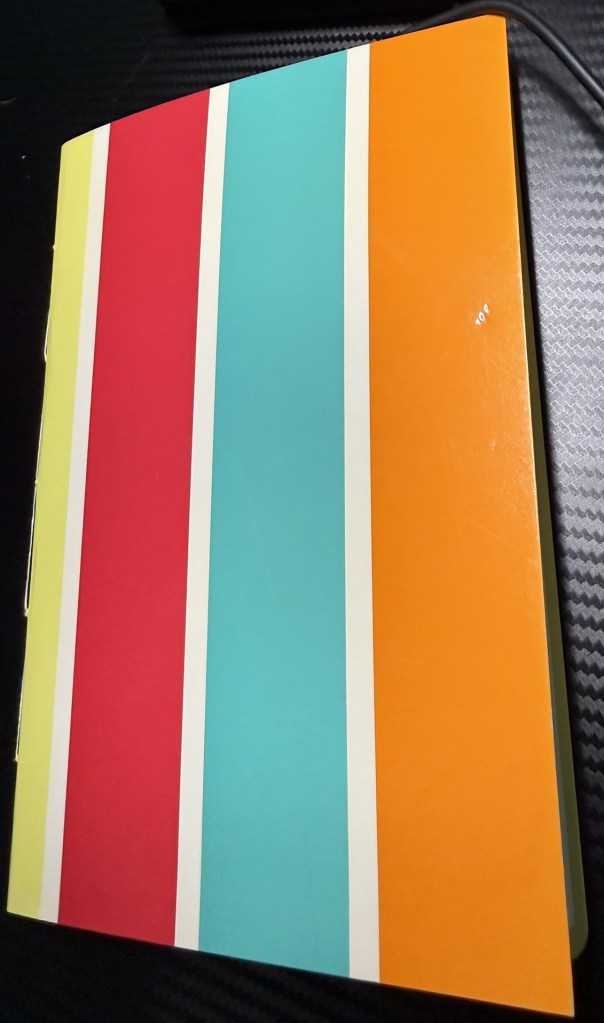
As you can see, I was entirely too heavy-handed with the mildliners…
I try to use what I have on hand, but for the life of me, I couldn’t get a good template because everything I had was either too flimsy or too much.
I have some waxed thread, but it’s meant for upholstery repair and gave me a lot of problems between the wax and the thickness.
I also have a ton of embroidery thread, but it’s too thin to work with on its own, and I kept shredding the covers.
I had purchased cardstock, but I didn’t get the right finish, so it looked like I had made a construction paper notebook for my third-grade dinosaur project.
I want to make A5 notebooks, as well as traveler’s notebook-style notebooks, but A5 paper, being slightly different from letter size, somehow costs far more than letter paper.
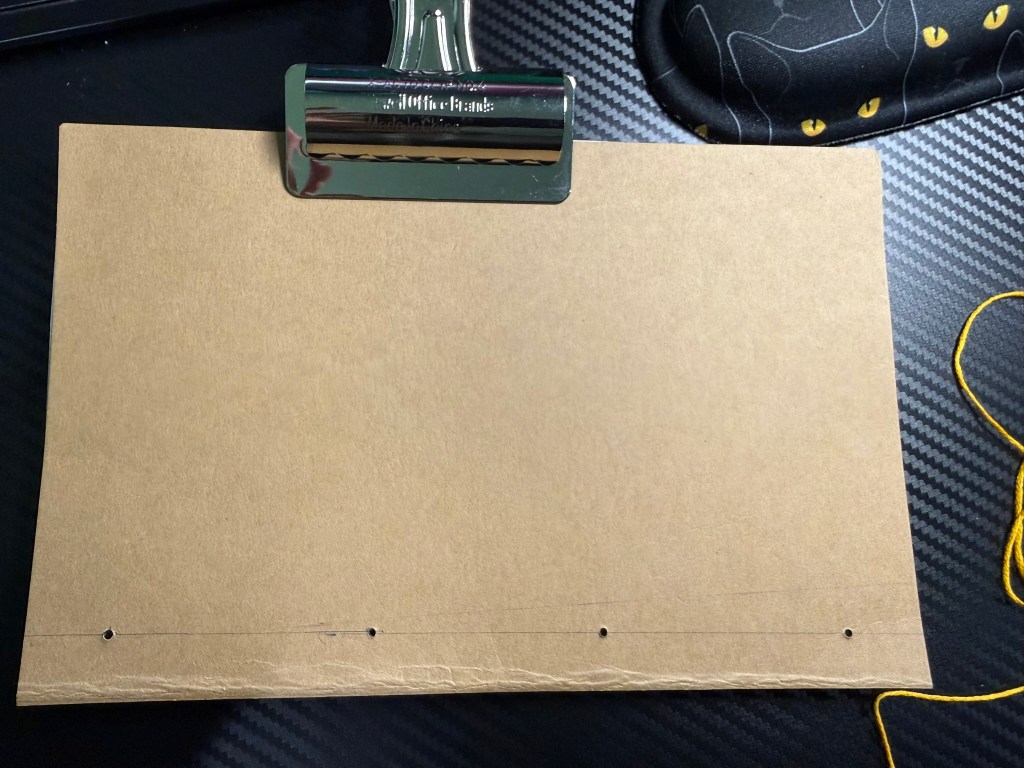
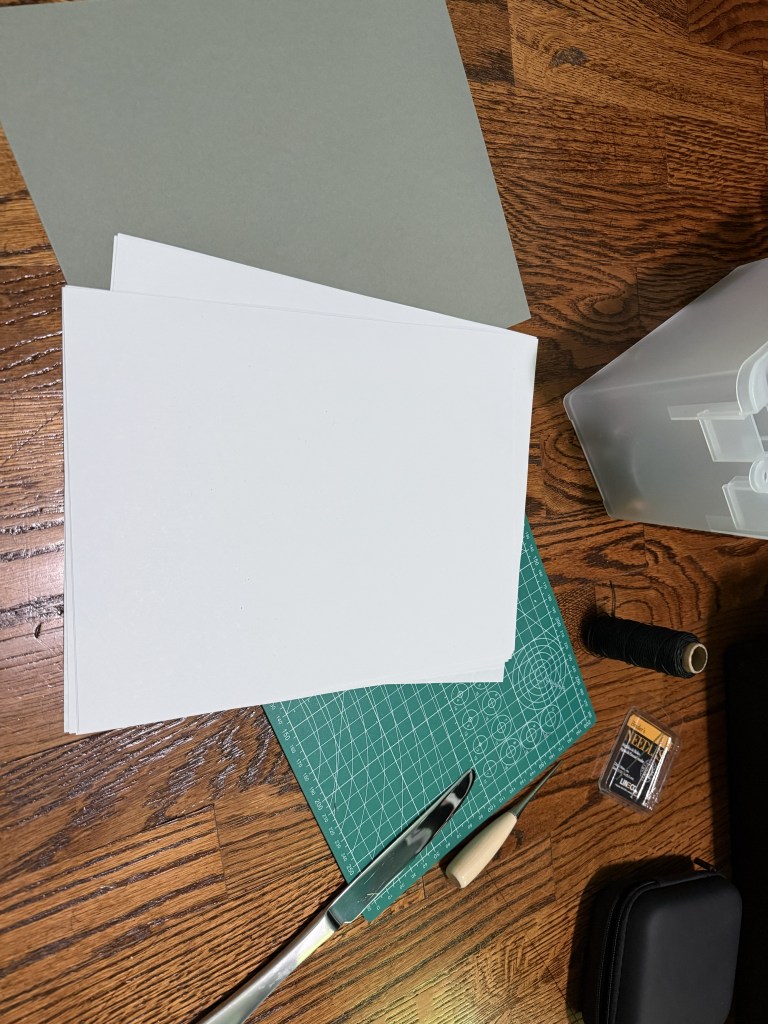
So…I found some letter-sized chipboard and decided to try again with printer paper and some embroidery floss that arrived today.
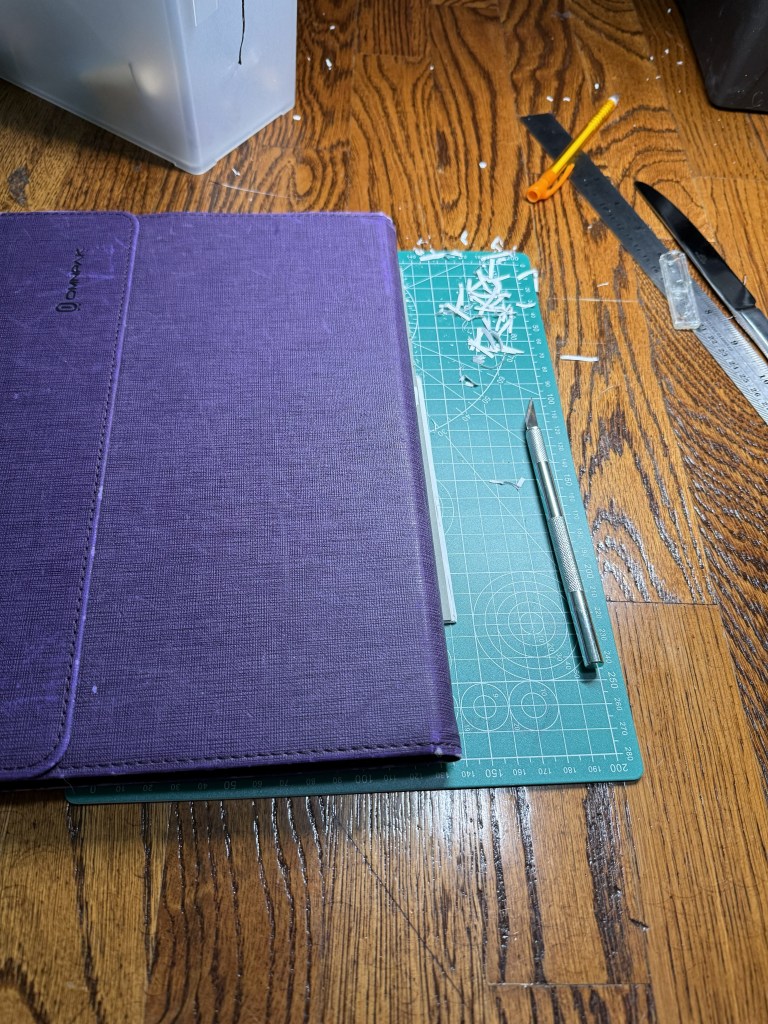
Here is the setup once I got all the paper cut and the holes poked through:
The next problem was that my bookbinding needles don’t have eyes large enough for embroidery floss. That seems like something a bookbinding needle should be able to handle, but what do I know?
I finally found a needle that would work—from my upholstery repair kit—and of course it broke after going through the first hole.
I found another upholstery needle that did work, finally.
This attempt went much better than the last, especially because I bought a paper guillotine and wasn’t cutting every page by hand. Clearly, I like to punish myself by cutting single sheets of paper one at a time…
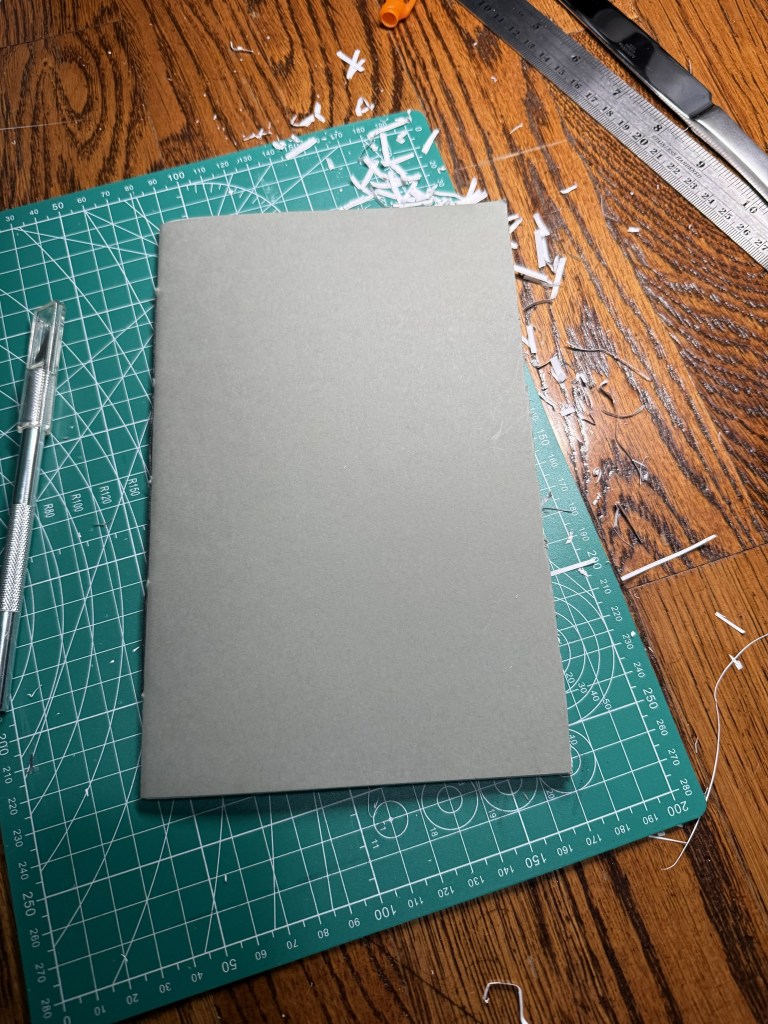
I’m pleased with my second attempt, knowing I still have a long way to go.
I also need to remember to hinge the front cover before I sew everything together. Preferably with the Teflon bone folder.
My last post discussed hitting a creative block, which in turn has caused a bit of an internal struggle. I want to keep creating, but I also don’t want to force myself—nothing kills my passion faster than feeling trapped.
Today, I told myself I had to do something. I decided to bind another pamphlet, since it really doesn’t take a lot of time or effort (at least, minimal effort for my current skill level).
I had a file folder lying around that I thought would make a nicer cover than the card stock I had been using. I also wanted to try out my Teflon bone folder.
The folder was a little larger than the paper when folded in half, so that removed the “trim the paper” equation entirely. However, I have not mastered scoring yet, so when I folded the file folder, it still ended up with some weird creases.
I also wanted to try the other thread that came with my upholstery repair kit. That thread is more like regular sewing thread, so I had to tread carefully. I had been using the thicker waxed thread, but it didn’t tighten well and ended up looking really messy.
I made the holes in the paper, and they were a bit off-center, as usual. I plan to make a book-piercing stand at some point, but since I am still practicing the binding itself, that can wait a bit.
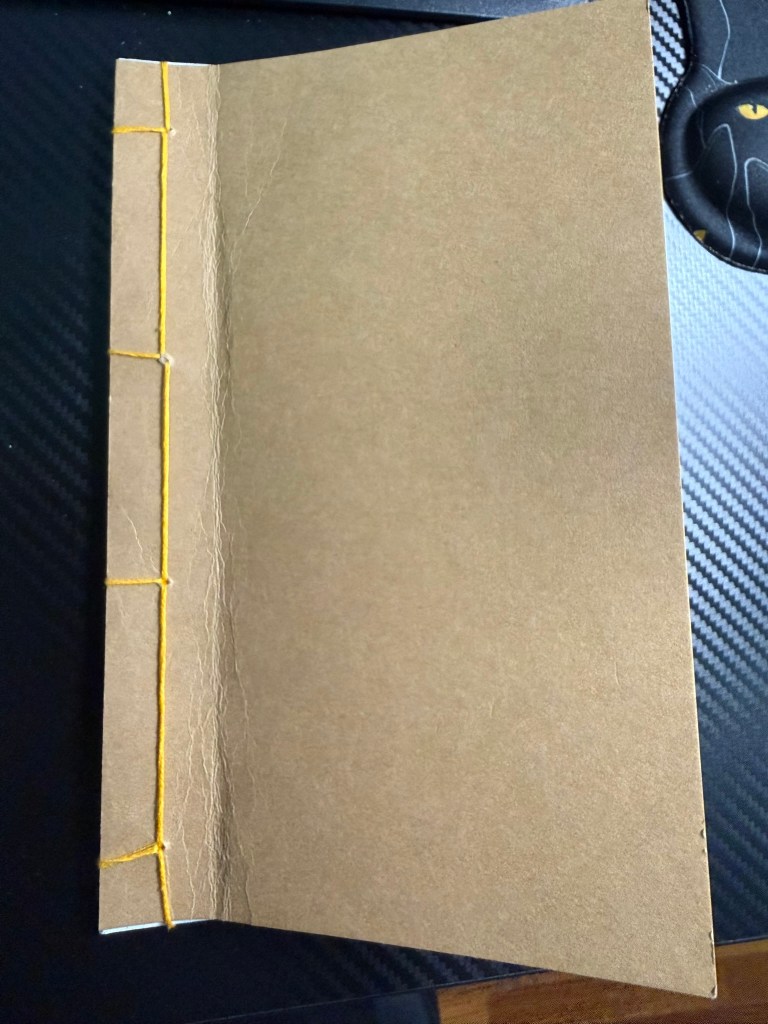
The sewing went faster this time since it wasn’t my first try, and I am happy with the overall look.
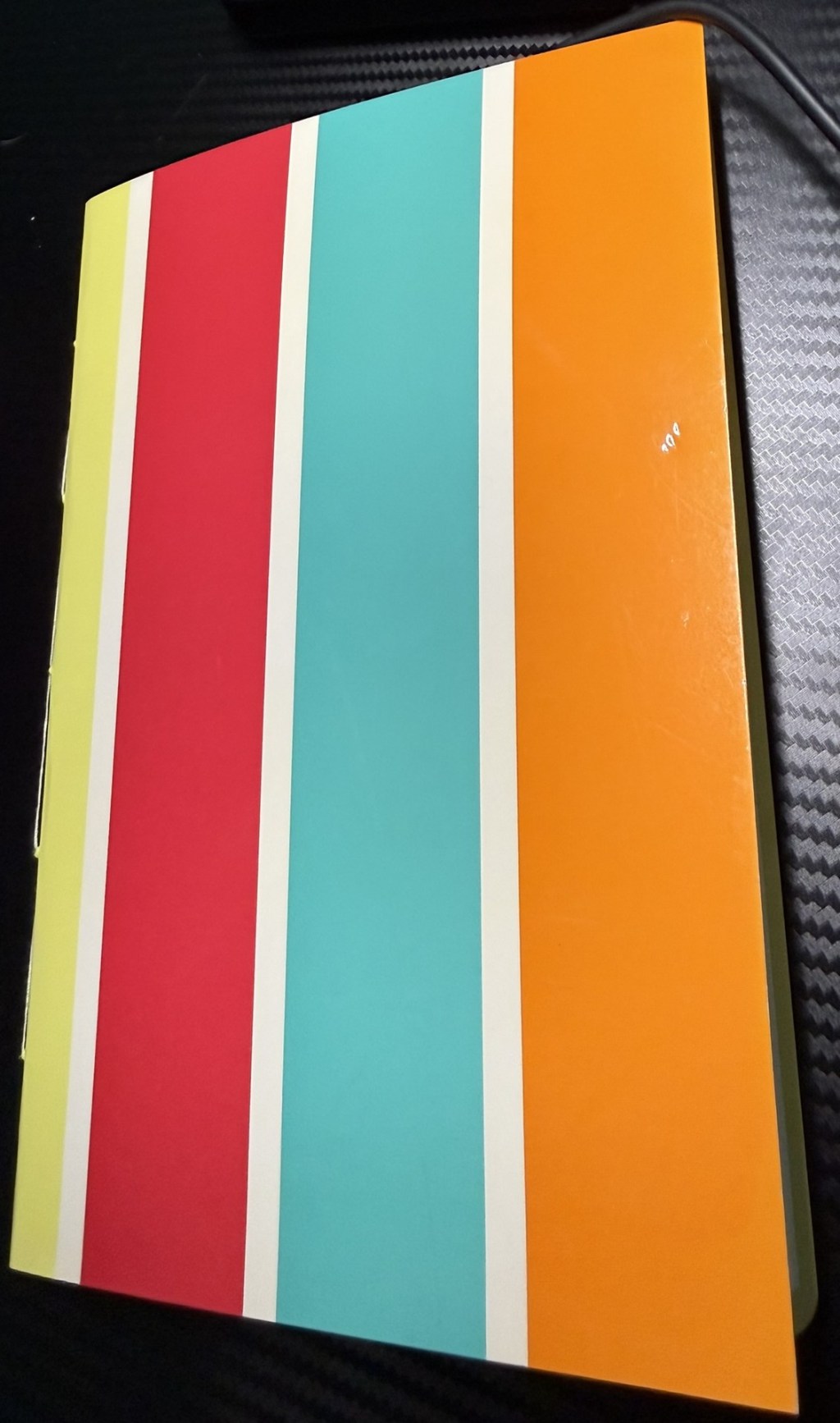
I love that the thread is unobtrusive.From the outside, the file folder made a much nicer cover than I expected.
I believe I have mentioned before that I find a topic, obsess over it for a while, then totally forget about it.
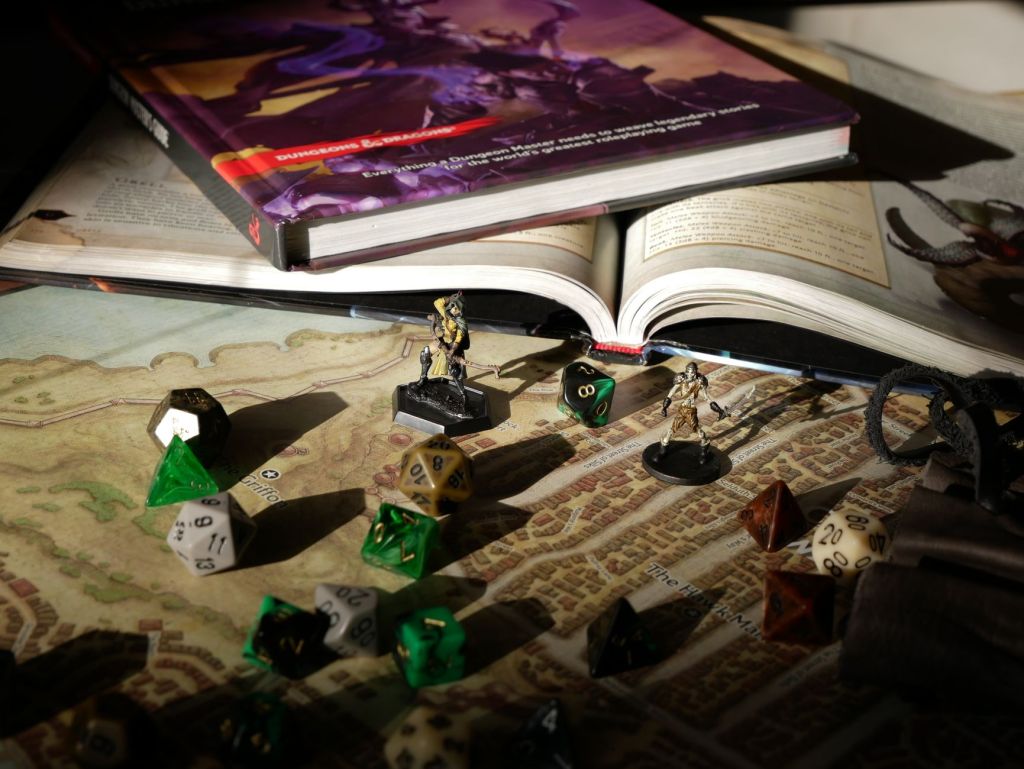
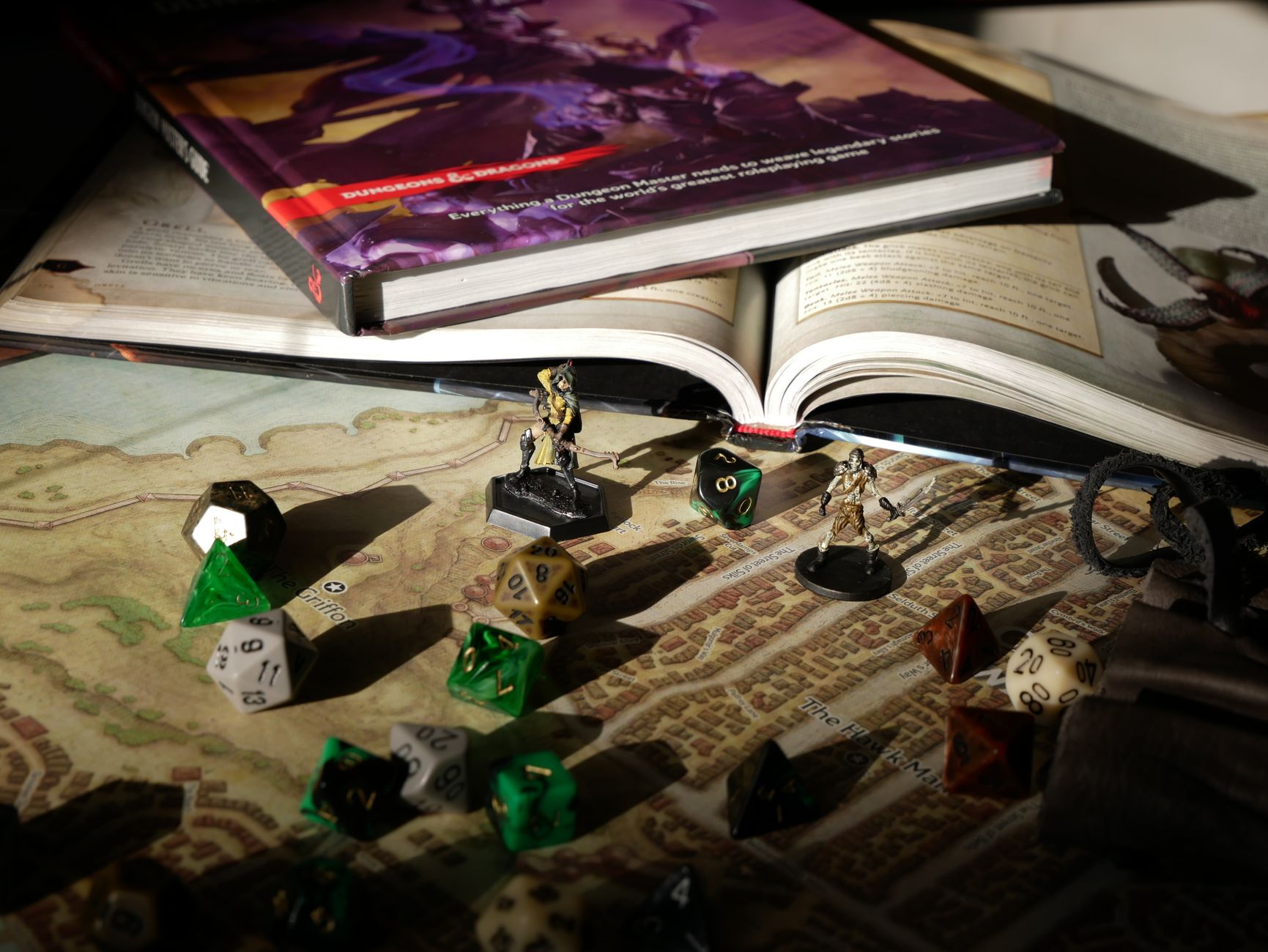
Right now, it is Baldur’s Gate 3.
I bought the game right after it came out, along with a Steam Deck, played for about three weeks, and then my Steam Deck sat untouched until about a year ago. So obviously, now that I am obsessed with Baldur’s Gate 3 again, I started playing it on my PC instead. The Steam Deck is busy with my other game.
I have been reading the D&D Player’s Handbook for the past week so I can get a better idea of how to set up my character in BG3. I also bought Sword Coast Adventurer’s Guide because there is some lore I am lacking.
Have my notes evolved into yet another commonplace book? You bet they have.
In a week or two, I will probably be able to rattle off any number of feats, backgrounds, classes, and spells. In two months, I will be focused on something else entirely. It’s just how it is with me.
This is, of course, happening right after I bought a new desk with about twice as much real estate as the old one. My monitor is pretty big, so before, there wasn’t room for much besides a keyboard and mouse.
Naturally, I am already covering the new desk.
I started more Jewish studies, so that notebook is sitting on top of the related binder and my current book. Then there is my garden compendium. I 3D printed two desk organizers. Of course I also had to make room for my cat Post-It dispenser.
And more pens. Always more pens.
I also have a hankering to make some notebooks, but I am waiting on a Teflon bone folder, which should arrive tomorrow. Given the current state of my desk, what I clearly need is more notebooks.
When I was working on my master’s degree, I also had to learn how to use Chicago/Turabian citations. Before that, I’d had classes that required MLA and APA, but Chicago/Turabian turned out to be a whole different beast. No matter how hard I tried, I always seemed to lose a point or two because I’d gotten something wrong.
When it came time to write my thesis, I decided I wasn’t dealing with that anymore. Every time I accessed a source, I wrote down everything about it: title, author(s), publication date, publisher, and anything else I might need. Then I wrote down the correct format for the first footnote, subsequent footnotes, and the bibliography.
That meant that when I was actually writing, I could just write. I didn’t have to stop every few minutes to figure out how I was supposed to cite something and potentially lose my train of thought. And when the paper itself was finished, dealing with the citations was a whole lot easier.
A few months ago, I found myself thinking, “I wish I’d had something like this way back when…” And then the lightbulb went off. Why not make it? If it made my life easier, maybe I could save someone else from suffering through the same thing.
As it turns out, making the templates took more time than learning Chicago/Turabian in the first place.
I had to jump straight into the deep end with Scribus, the open-source design tool I’d found. I have to admit, I said some fairly offensive words to Scribus during the process, but luckily it’s not a person I’d have to apologize to later.
I can’t say that I’ve beaten Scribus, mastered it, or even reached anything resembling ease of use, but I at least remembered to save my completed pages as templates so I don’t continue to tear out my hair.
Some days just don’t go very well. Some days seem like every attempt at anything at all just doesn’t work. Then you need a win.
This doesn’t mean it has to be perfect…just something that sort of works.
I needed a “brain break” (for lack of a better term) but I still wanted to practice something. I decided to find a bookbinding technique that was easier than Coptic or Japanese stab binding, but I didn’t want to do accordion binding, which is basically folding paper like an accordion and sticking a cover on each end.
Pamphlet binding it is! I found a tutorial for five-hole and got to work. I wanted to keep it simple, so I got 8 sheets of printer paper and a piece of my 250gsm cardstock. Plus, of course, my bookbinding tools.
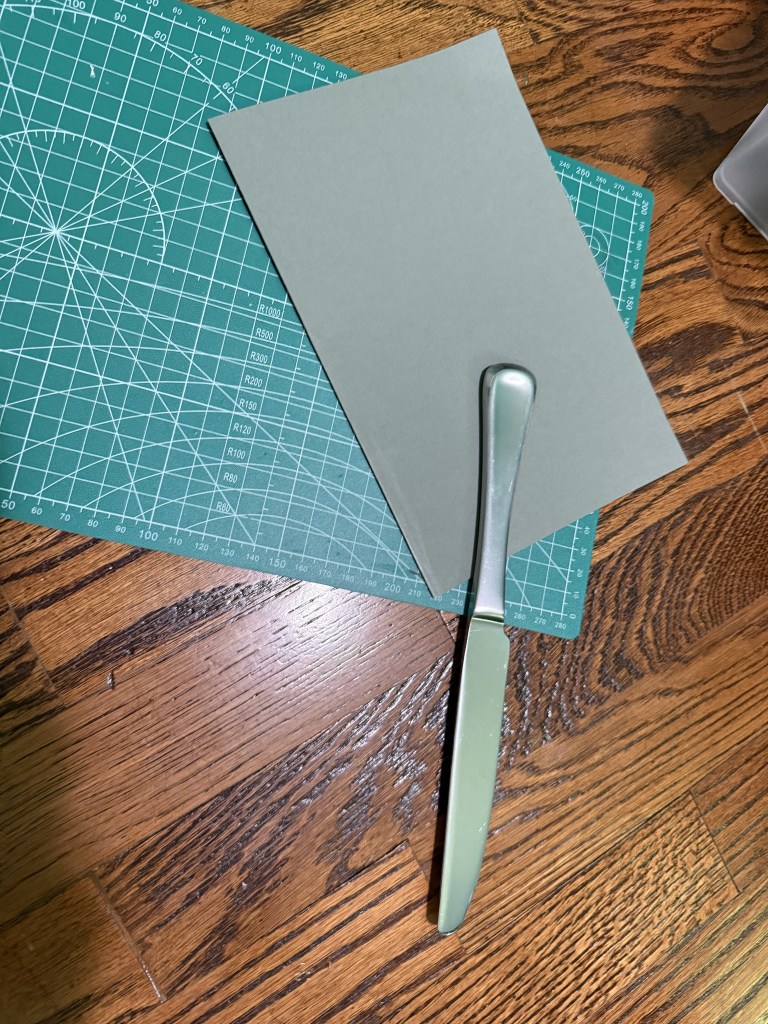
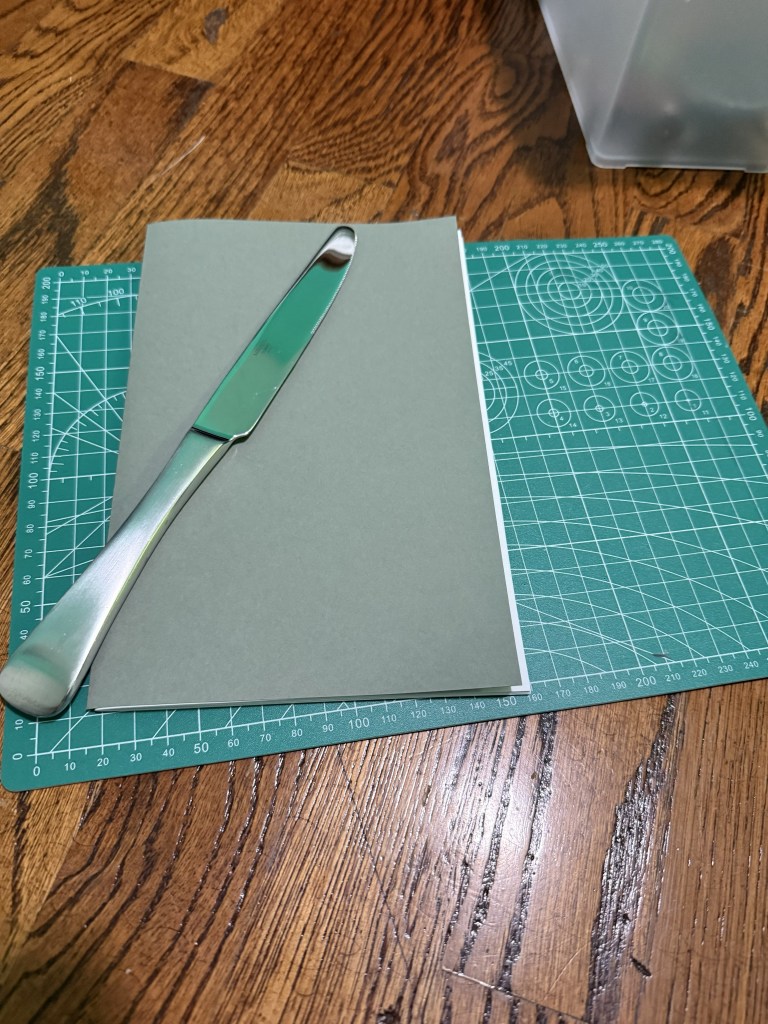
I took the sheets of paper and folded them in half all together, the same way I did for my Coptic attempts. I used the handle of the knife to really crease the folds and keep paper creep at a minimum (I am terrible at trimming, as seen later). Note: I used the knife because it works just as well (IMO) as a bone folder and it is something I already have on hand.
I scored the cover separately and I am not sure why, so I will probably try everything together next time and hopefully not have to trim.
Scored pamphlet with obvious need of trimming.
I decided to sew, then trim. Which wasn’t the best option, but hey, it was my first time.
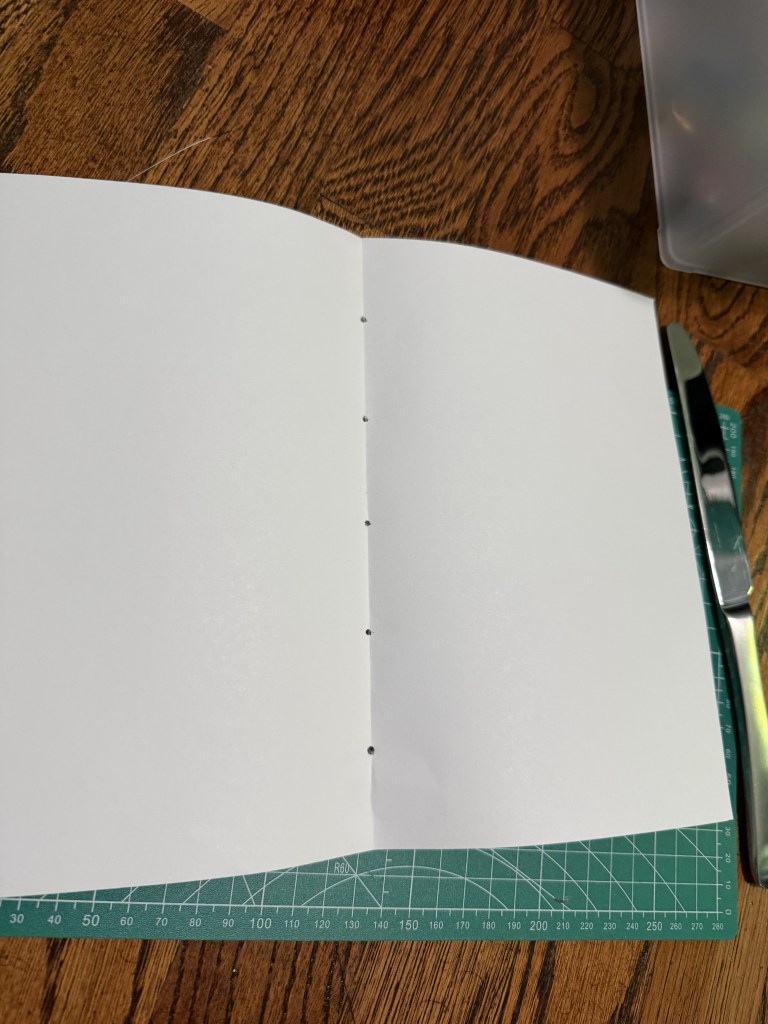
So…first I marked where the holes should be for sewing. Then I used my awl to poke holes through. Pretty straightforward.
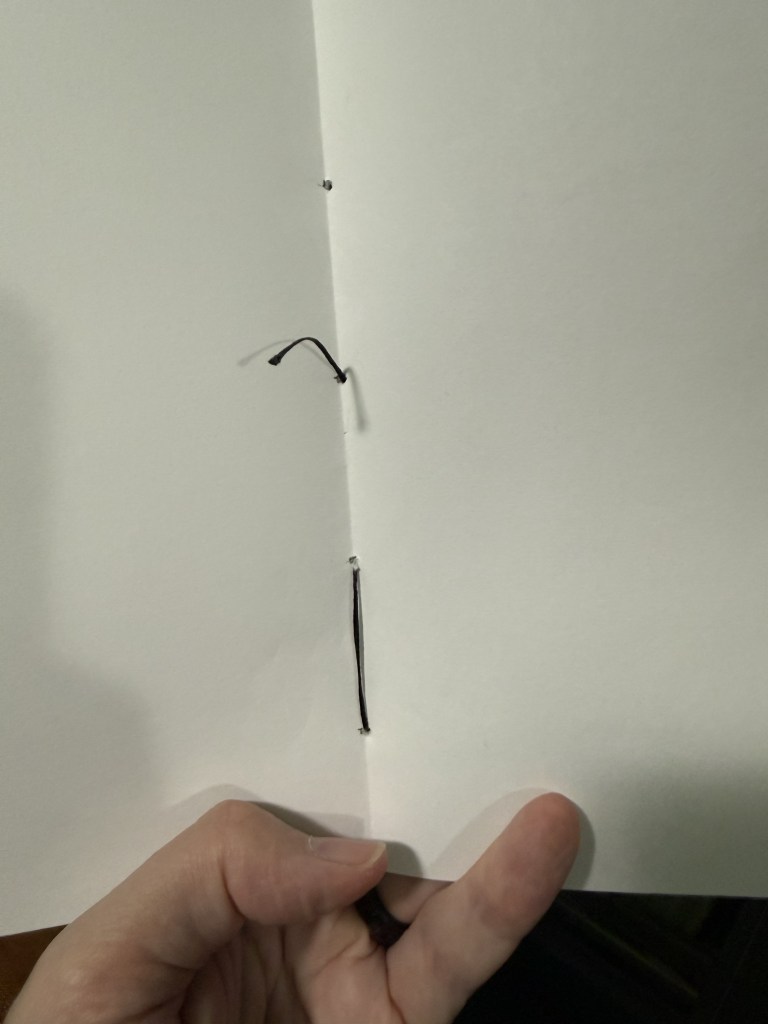
Here is the inside of the pamphlet after the first stitch:
I do have trouble with the waxed string I am using – it is hard to pull it tightly without ripping the paper, so in the future, I need to find something in between this and the regular sewing thread I have at home.
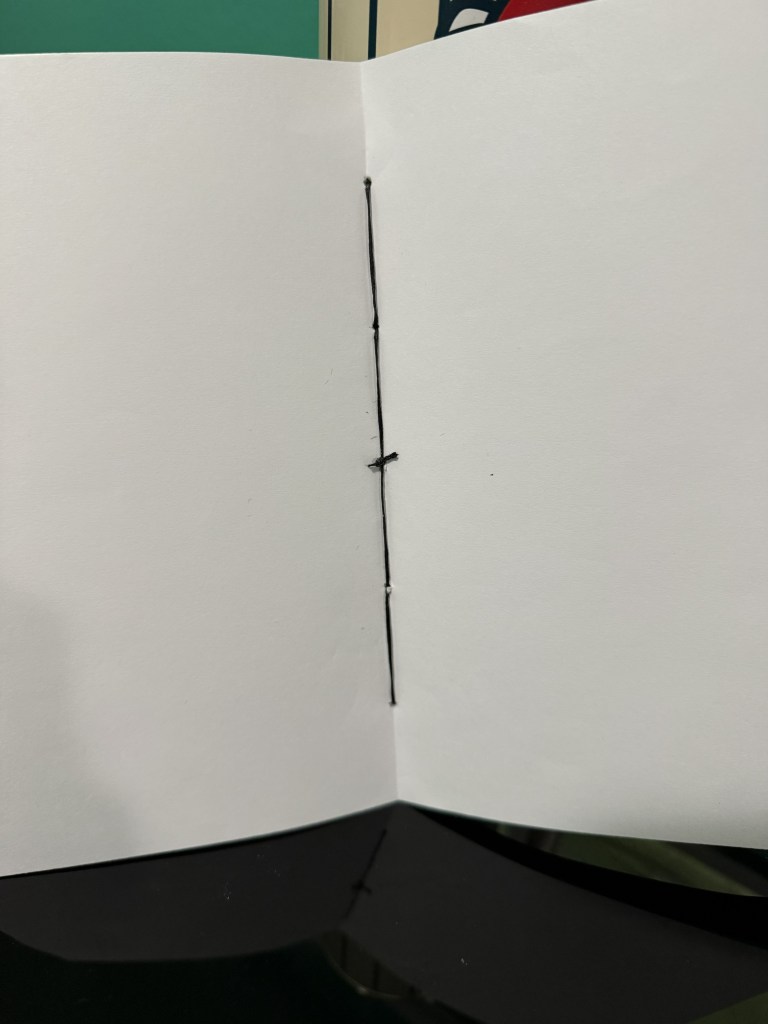
A few minutes later, I finished the stitching:
I think it looks cool! Simple, but cool and useful.
Okay, I promised to talk about trimming…as shown above, the paper was sticking out of the side of the cover quite noticeably. And if you’ve read my other posts, you know this is unacceptable.
So I got out the cutting mat and an x-acto knife. I had to set something heavy on the pamphlet so the pamphlet wouldn’t suddenly shift, the knife wouldn’t launch into my finger/hand, and give me yet another (!) X-Acto knife scar. Don’t ask how I got the first one because it was just me doing something too quickly and without thinking through the issue.
I was trying to be soooooo careful here. And then I sliced through the edges of the cover multiple times. Which caused a lot of not-so-nice words to flow out of my mouth.
Hence…I need a better trimming method. Trimming a finished pamphlet with an X-Acto knife and hoping I wouldn’t hit the cover was apparently not it.
Anyway, if you don’t look too closely, it turned out mostly fine. And once I practice a bit more, I feel confident I can resize future notebooks and use them in the traveler’s notebook-style cover I made a few months ago. Which means I could eventually make my own refills instead of ordering more.
I have had the worst time trying to learn how to crochet and/or knit. I can “cast on” (knitting), which goes on the needle in the dominant hand (in my case, the right). Then when you start the knit stitch, somehow I have to swap hands so the cast on needle is in my left hand, then stick the right needle in there and make some kind of magic that results in knitting. So obviously the cast on stitches fell right off, and obviously again, I threw the needles across the room.
Now for crochet…this one was a tad easier for me but I had to work in stages. The first two times I tried, I could get a chain but then no magic. The third time, I was able to get one row. The fourth time, I was able to get two rows. I have not tried again, because to get to those results required unraveling my chain at least four times.
Then…I found something called Tunisian crochet. Supposedly it is easier than both knitting and regular crochet, and results in material that resembles knitting more than crochet, and potentially uses less yarn. I do like things that use less resources…
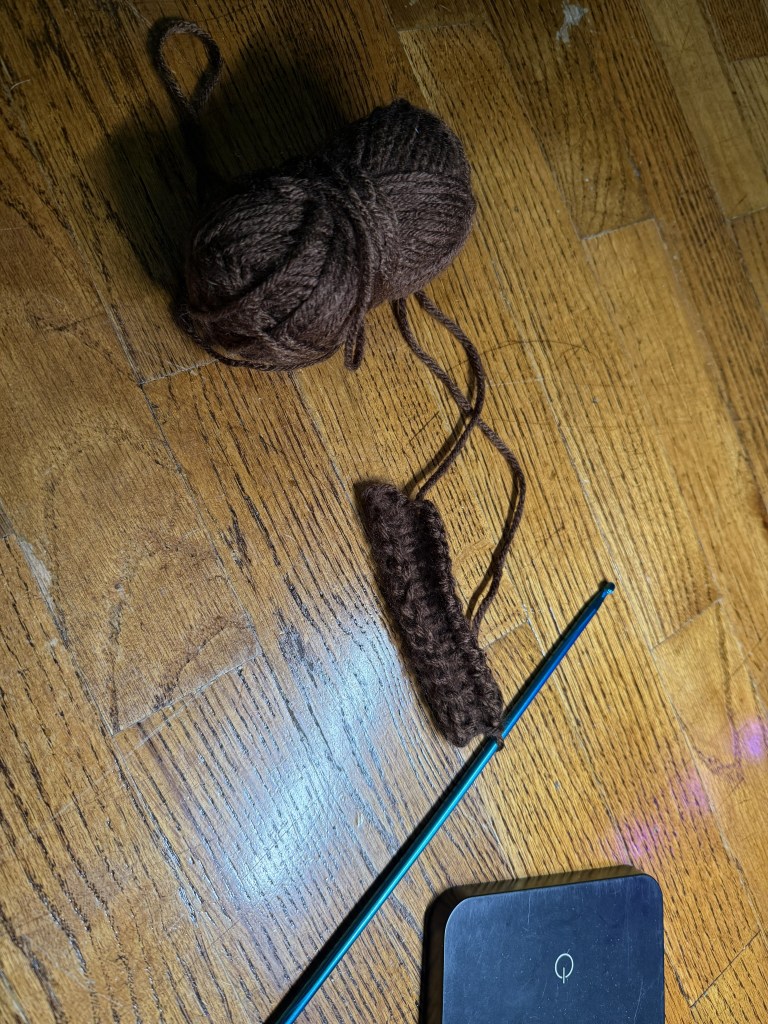
I got my Tunisian crochet hooks yesterday (because of course I had to order them immediately). I got out the yarn from my “easy” learn to crochet kit.
So here is where the frustration starts…my initial learning resource was a 1970s Reader’s Digest The Complete Guide to Needlework. I had always enjoyed looking at this as a child, but for actual learning, vague drawings and pictures of a finished stitch just aren’t enough for me. Moreover, this book assumes one already knows regular crochet before a 1/8 page dip into Tunisian.
Thus, I headed to Google to find a tutorial. I found one that looked promising, but again, it seemed to assume I already knew how to crochet…or at least the lingo. I had instructions such as “YO [yarn over for those who also don’t know the lingo] and draw up a loop.” What? The result of this was a stranglehold on my needle and nowhere to go.
I had to ask ChatGPT to translate these instructions for me, and it happily complied. Thank goodness! So in less than an hour, I now have a few forward and return passes. Once I was able to figure out what everything meant, it turned out to be fairly easy. Other than the tension issues of course. And perhaps…actually counting my stitches correctly.
But I feel like this is going to grow into something I can actually use to make things! And not enrage me to the point I am throwing needles across the room.
Please excuse the obvious tension and miscounting issues here. And when I say this is somewhat “easy,” I don’t mean I’ll master it anytime soon. I mean that, unlike my previous attempts at knitting and crochet, I can actually imagine making something with it.
There is now a reasonable possibility of a scarf within the next six months.
I lost count of forward and return passes…perhaps four?
A while ago, I wrote about why I think people misunderstand what Duolingo is actually good for. Apparently, I needed to start learning a fictional language to prove my own point.
Three High Valyrian lessons in, Duolingo has already taught me two grammar rules without ever explicitly teaching me either of them.
I wasn’t going to try learning this fictional language, since I am already learning two that don’t have a lot of native speakers (especially Gàidhlig). But I also don’t like to rely on captions to give me the correct translation. Hence the original reason for learning Gàidhlig: not trusting Outlander to tell me what that sneaky Dougal was communicating.
Last night, we were watching House of the Dragon when the characters started speaking High Valyrian.
My spouse asked, “How much of that did you understand?”
“I’ve only had two lessons.”
“Yeah, I know.”
Fair.
But two lessons had already been enough for me to start noticing patterns. I figured out that vala (man) becomes valar (men) when it changes from singular to plural. Then today, I encountered vali. Same noun, different ending—and this time, the change wasn’t about how many men there were. It was about the noun’s role in the sentence.
Duolingo hadn’t stopped to explain either change to me. I figured them out by seeing the words used in context.
I’ve never truly studied Latin. After taking years of French, the addition of declensions made my brain hurt, and I really should have learned Latin first so that French was easier. Lesson learned, I guess.
High Valyrian seems to have a lot of declensions as well. So I will be writing down everything I can about word order, noun and verb endings, and whatever other patterns I start to notice.
This whole endeavor reminds me of taking the DLAB (Defense Language Aptitude Battery) when I served. I only needed to score 100 to be able to study one of the more difficult languages, like Arabic or Mandarin. I ended up scoring a 137, but unfortunately, the recruiter I spoke with said I could reenlist “open contract” instead of promising me a job as an interpreter or translator.
Nope.
So I opted out.
At any rate, the DLAB was a super fun test. It had two parts. In the first, you basically filled in words in a comic book using context clues from a made-up language. After that came a listening section, where you were given one grammar rule at a time, then listened to something and had to figure out the correct translation.
There were seven total grammar rules, and they were cumulative. By the time you got to number seven, you’d best remember the six that came before it.
Thus, learning a fictional language like High Valyrian isn’t entirely new to me.
As I was gardening this morning, I finally made the connection between what I’m doing with High Valyrian and how much I loved taking the DLAB (nerd alert). I’m being given unfamiliar words, seeing and hearing them in different contexts, and figuring out the rules from the patterns.
Which brings me right back to Duolingo.
One of the complaints I see about Duolingo is that it doesn’t explicitly teach enough grammar. And that’s true: it often doesn’t sit you down, explain the rule, and then ask you to practice it.
But that doesn’t mean you aren’t learning grammar.
Sometimes it gives you enough examples that your brain starts asking, “Wait. Why did that word change?”
And then you see it again.
And eventually: Oh.
There’s the rule.
Three lessons into High Valyrian, I’ve already had that happen twice.
Apparently, give me a made-up language and some context clues, and my brain is perfectly happy to do the rest.