I don’t know what it is this week, but everything I’ve tried for the second time seems to have been far more difficult than the first.
I managed a row of single crochet for the first time, then immediately discovered I was incapable of doing it again. And this notebook…
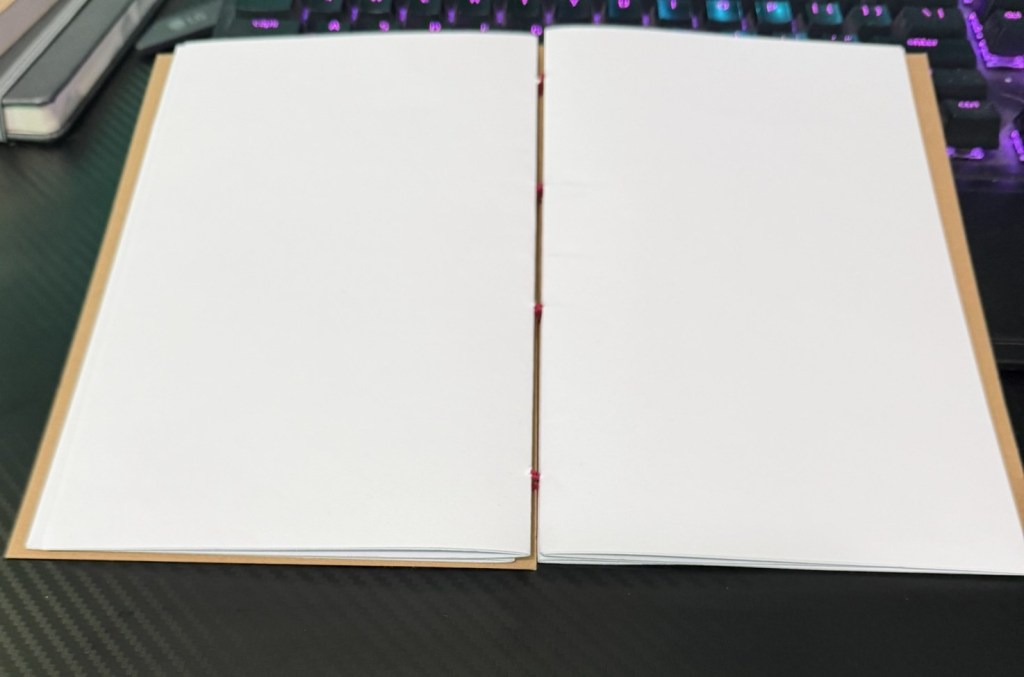
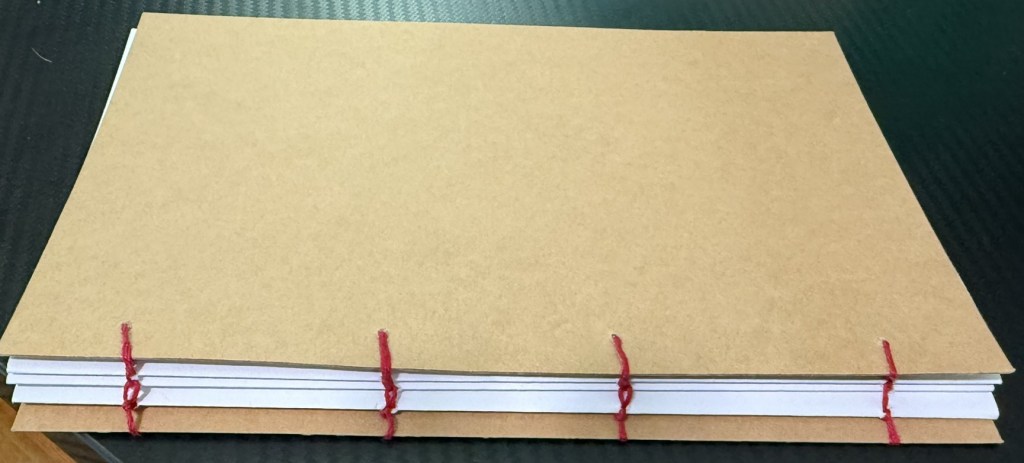
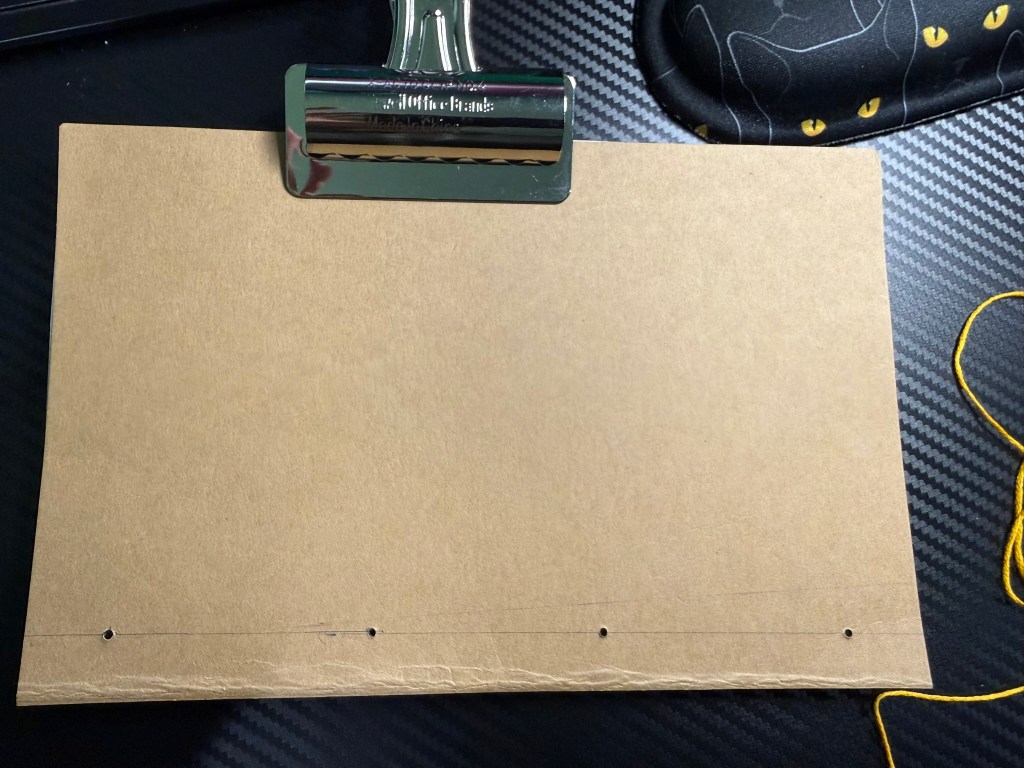
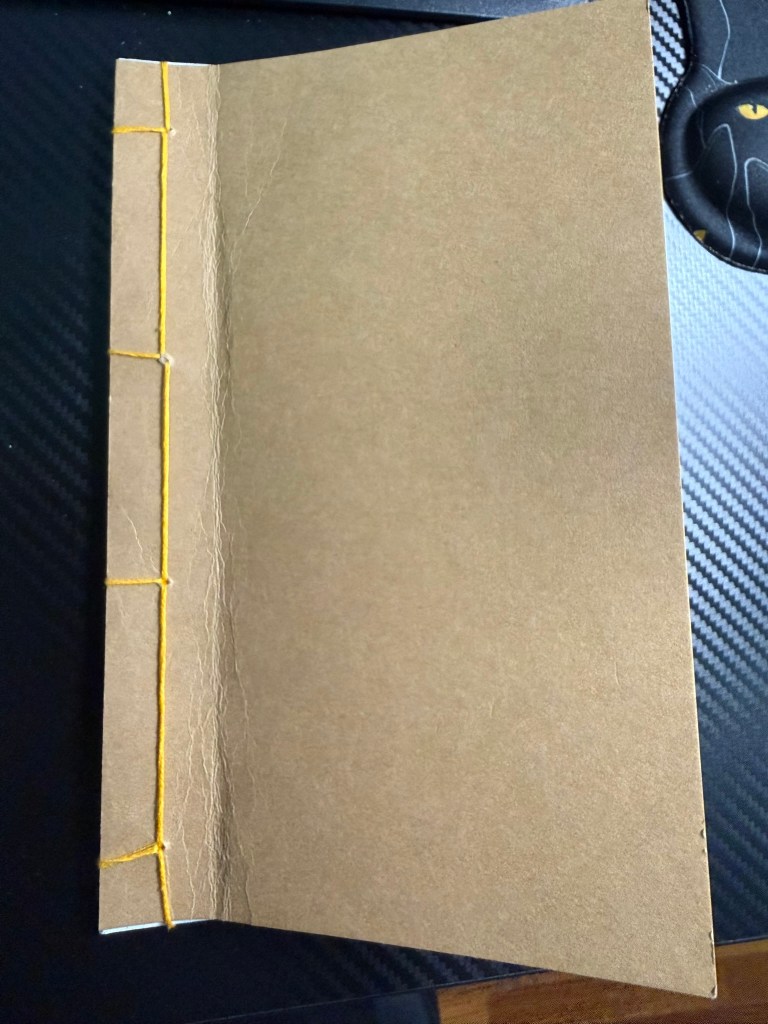
When I made my River Song planner cover, I removed the paper block completely intact—glue, stitching, and all. Naturally, this led me to think, “Why not make a tiny, tiny A6 Coptic notebook?”
I already knew black paper behaves more like cardstock than regular paper, so I planned accordingly: four signatures, two sheets per signature, plus some black cardstock I already had set aside for the covers.
First, either the cardstock I bought is too heavy, or someone on the internet lied to me about how well it would work.
Second, my bookbinding needles are apparently designed for projects much larger than a delicate little A6 notebook.
Third, my only thread option was from an upholstery repair kit that, for reasons known only to the manufacturer, included regular sewing thread. That was probably a blessing for a notebook this small, but it’s definitely not going to hold up for anything larger or thicker.
By the time I finished, I had used several words I wouldn’t say in front of my mother.
The upside of making such a tiny notebook is that it’s difficult to see the sewing details. Since I don’t think my stitching was particularly impressive, that’s probably for the best.
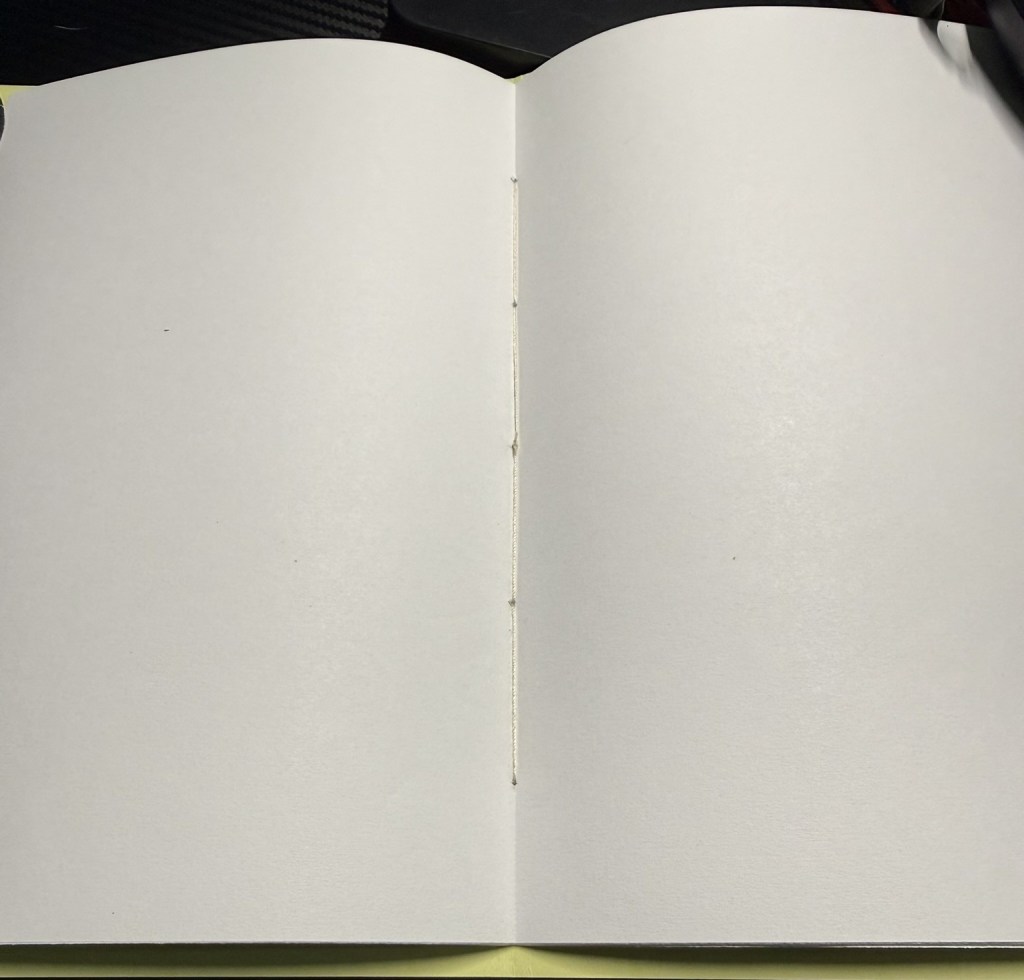
But hey—once again, it lays flat.
At this point, I’m beginning to think that’s becoming my signature accomplishment.
Get it? Signature?
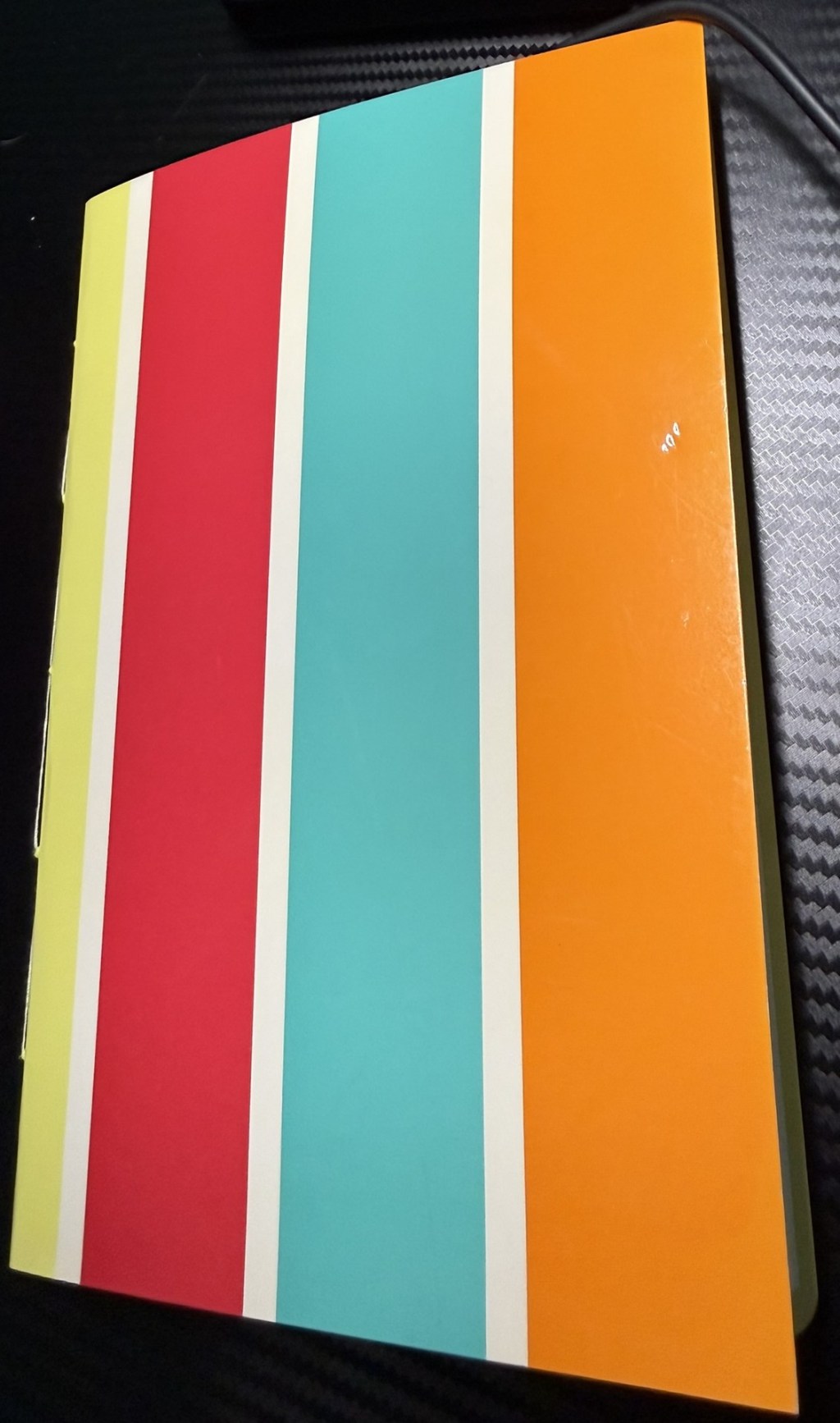
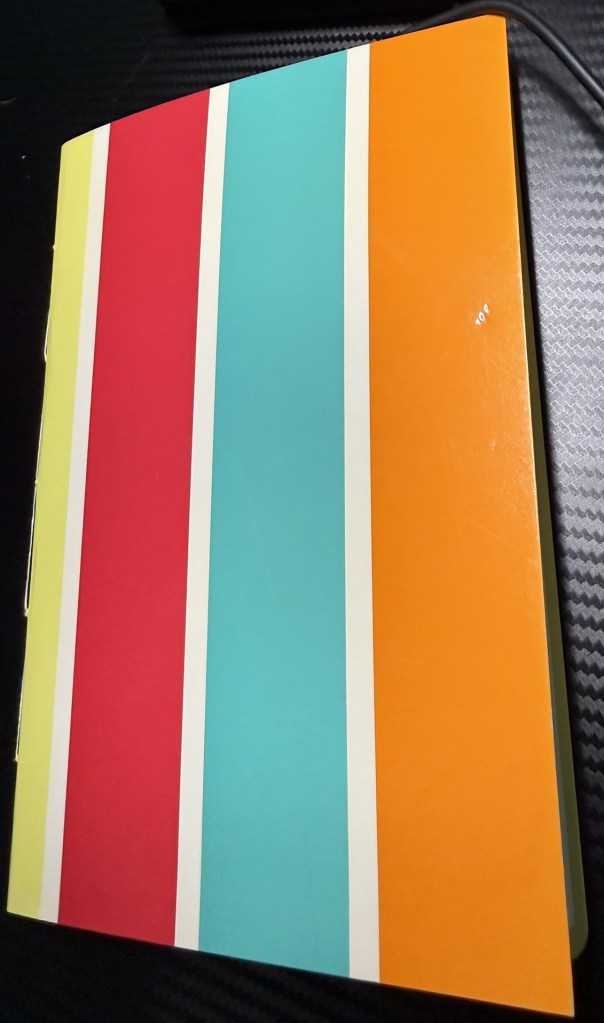
Pages repurposed from a different notebook.Front cover with holes.Finished notebook from the side.It lays flat!
This is not an actual photo of me – credit to ChatGPT for the image generation.
I have spent years feeling inadequate because there is so much I want to learn that I eventually become overwhelmed and end up touching none of it.
At the moment, I am studying four languages. I am still in the phase where my brain immediately reverts to French because it was the first language I learned outside of English.
There are currently four commonplace books in my bag. One of them is completely blank, just in case.
I carry a pen case full of stationery tools I “might need,” along with a Kindle Scribe.
I want to write a dissertation on the Scottish Highlands around the time of Culloden. Or perhaps another period of Highland history. I still cannot decide.
I want to learn to knit so I can make beautiful sweaters and shawls.
I am trying to grow my own food and learn how to can it, partially because gardening fascinates me and partially because apparently some part of my brain is preparing for a zombie apocalypse.
I want to make paper and ink.
I am going to spin my own yarn someday and dye it using plants I have grown myself.
I am designing a planner that actually fits the way I think and work instead of settling for something mass-produced.
I am binding notebooks by hand because it turns out I genuinely enjoy it.
For a long time, all of this made me feel like a failure. I constantly felt behind. Surely, if I were more disciplined, more focused, or more organized, I would already be proficient at half these things.
Eventually, though, I realized something important:
You cannot dedicate your entire life to mastering dozens of subjects simultaneously.
Some seasons of life are for language learning. Some are for gardening. Some are for theology, history, sewing, bookbinding, or note-taking systems.
Some days I spend hours studying Torah. Other days I spend six straight hours documenting Norwegian vocabulary and grammar rules in my learning compendium like a Victorian scholar who has just discovered Scandinavia.
And honestly? That is fine.
I have stopped trying to force myself into becoming a hyper-efficient machine optimized for productivity and mastery at all times.
Now I mostly try to ride the wave of whatever is currently lighting up my brain.
The interests eventually circle back around anyway.
You do not have to learn everything at once.
You just have to stay curious enough to keep returning to the things you love.
There have been several studies showing that people tend to remember information better when they write it down by hand. For me, that has absolutely been true. Hence the ever-growing stack of commonplace books around my house.
One study discussed in Scientific American explains that typing involves repeating the same simple finger movements, while handwriting creates distinct physical motions for each letter. According to Audrey van der Meer, who spearheaded the study, handwriting helps lock the motor and sensory systems together.
I won’t get too deep into the science here. That isn’t my area of expertise. But looking back, I wish I had been able to handwrite more of my notes in law school.
I tried for a week or two. Eventually, though, the professors spoke too quickly for me to keep up effectively by hand. I switched to typing instead, organizing everything neatly in OneNote by class, with individual pages for each topic on the syllabus. My organization system was solid. The problem was retention.
I’m also not the type of person who can compulsively reread notes over and over again. That makes it especially important for me to absorb the material the first time I encounter it, and handwriting seems to help with that.
In high school, we had spelling tests where we memorized vocabulary terms alongside their definitions. During the test, we had to fill in the correct word next to each definition. Because I had physically written the words down beforehand, I could often close my eyes and “see” the page in my head. Even if I couldn’t immediately remember the correct word, I could remember where it had been positioned relative to the others on the list.
That kind of visual and physical memory still seems to matter for me now.
At any rate, I love creating these various and often random commonplace books. I don’t have to learn at someone else’s speed. I can sketch diagrams where needed. I can reorganize information however my brain naturally wants to process it. For me, it’s simply a better system.
The funny thing is that I never really learned how to study. As a child, most schoolwork came easily to me, so no one ever thought I might need actual study strategies later on.
Over the years, I have Googled and browsed Pinterest trying to find the “best” note-taking system. One method that appears constantly is the Cornell Method, where the page is divided into three sections: a narrow left-hand “cue” column for keywords or questions, a larger note-taking section on the right, and a summary section at the bottom.
I tried it a couple of times and never found it especially helpful. Even the research surrounding the method seems somewhat inconclusive.
What I eventually realized is that I don’t need an elaborate system.
I just need something straightforward that works with the way my brain already processes information: plain notebooks, handwritten notes, and room to think.
No fancy handwriting. No planner stickers. Just paper.
And yes, I once asked ChatGPT for note-taking advice. It suggested mind maps.
I practically yelled at the screen.
They look so chaotic to me that I know I would immediately become irritated with my own notes and never look at them again.
When I first wrote about my commonplace book, it was mostly a place to gather notes and ideas. Since then, it has become something much more useful: part reference library, part creative workshop, and part record of what I’m learning now.
Like most good tools, it changed as I changed.
Commonplace books are often used to collect interesting information across many subjects. In my case, that has turned into several notebooks for several passions.
I have one dedicated to Highland culture, where I once half-seriously decided I should write a dissertation. I have another for Torah study and Jewish learning. I even bought matching notebooks for continuity and built a reusable Traveler’s Notebook-style hardcover, which I turned into a replica of River Song’s diary from Doctor Who.
My gardening notebook is one of the most practical. I drew the herbs I planted for easy identification, gave each herb and vegetable its own page with planting instructions and uses, and sketched a not-to-scale map of the garden with beds organized by water needs, height, and invasiveness.
All of this eventually led me to planners.
When I first discovered bullet journaling, planners, and sticker culture, I fell down the rabbit hole and bought far too much. Eventually I realized I am simply too minimalist for that world.
I tried the much-loved Hobonichi Cousin. It had many good features, but the pages felt too busy and included sections I knew I would never use. I looked at other planners and couldn’t justify paying premium prices for branding.
Then I found Wonderland222: clean, functional, and refreshingly minimal.
Even so, it still wasn’t exactly what I wanted.
So now I’m designing my own planner in Scribus. So far I have a daily page template and a calendar spread, but my goal is to arrange monthly, weekly, and daily pages in a way that makes sense to me. I’m also creating a custom baseball tracking section.
I’ll print it myself, bind it myself, and design the cover myself.
If it turns out well, I may even make a few for others someday.
The real lesson in all of this is simple: use what works for you.
Stickers didn’t work for me. Trend-driven planner culture didn’t work for me. Buying things because everyone else loved them didn’t work for me.
What did work was learning my own preferences.
I buy tools I can use for years. I choose quality over clutter. I build systems that support my actual life.
I don’t have any pictures to share yet, but I have been building a commonplace book for this endeavor. I have sections for gardening, recipes, and crafts. I have a separate one for learning Gaelic, so that is not included here. So far, I have a monthly task list for my garden (which I included because those are the ingredients I’ll be using in many of my recipes) and a vegan bannock recipe. One of these days, I will post photos, but right now I am shy about how messy it is. Which shouldn’t be a barrier, but it can take me a while to feel comfortable with that.
I was going to highlight the sides of the pages in the colors I chose for the sections, but I quickly realized that won’t work if I have, say, one page of garden plans and then one page of recipes, and so on. No one would be able to see the differentiation. I will likely try washi tape next, even though the thought of putting a strip of washi tape on every page sounds tedious. If anyone has any suggestions, I would love to hear them.
I do struggle with boring pages…there are people out there who are amazing artists and I love that they share that with the rest of us. I do not expect my pages to look like that, but I grow tired of just writing linearly down the page. So with my monthly garden tasks, I at least color-coded the months to break up the monotony. I also drew a couple strands of wheat on the bannock page and included a quote regarding bannocks by Robert Burns. That’s about the best I can come up with right now, but I am happy the pages are more interesting now.
I’m currently using an Amazon Basics grid notebook. I have TONS of notebooks and I have to use them before I can justify buying more. I find the grids difficult to use though, because they are visually loud, and the substance of my information can get lost. I have decided that the next time I need a notebook, I will buy A5 paper and print out dotted pages. After that, I will bind them. This need became apparent when I was looking for notebooks with more pages; I found many with 50-100 sheets, but I’m looking for 200+ sheets (not pages). I don’t want dozens of books hiding around the house. As it stands, I have a few old planners, an old commonplace book, two black paper journals that I found near impossible to use, several notebooks of certification studying, etc. I don’t mind having a separate notebook for something like a network security certification, but I don’t need four of them to talk about one thing.
Ugh, I just remembered the 8 brand-new engineering pads I bought before I changed my major to computer science.