Normally, I don’t post something the day I actually do it. But today, I was especially frustrated because I don’t feel like I’m making progress.
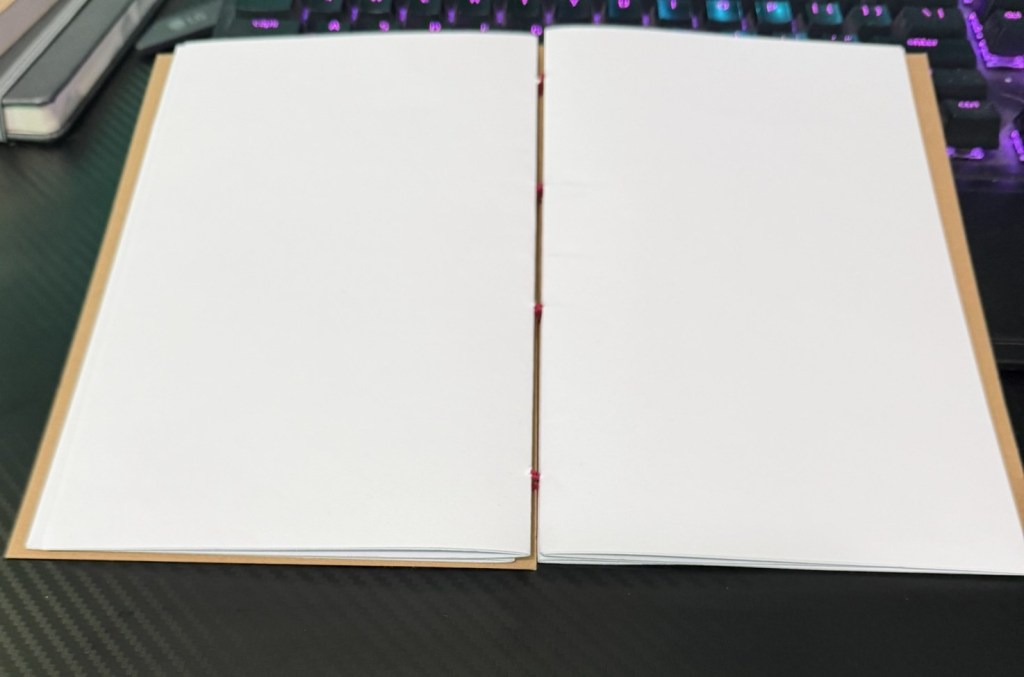
I bought some chipboard so I could try working with a more professional material. I’m still using printer paper for now, as I want to get this down before I start using my nice paper.
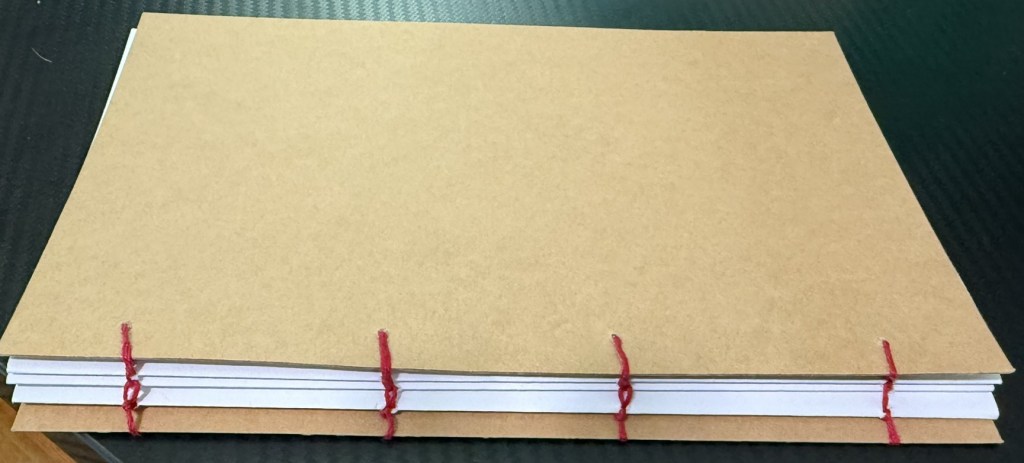
I made six signatures with five sheets of paper each. I wanted to make sure the stitching was visible, so I got out the waxed thread that came with my upholstery repair kit and threaded a bookbinding needle.
The waxed thread is very difficult to manage. I couldn’t keep tension, and I think it’s just too thick for bookbinding. I got to the third signature and realized I wouldn’t have enough thread for the other three, so I decided to just sew on the cover and call it good.
And of course…I was about 1/2″ short.
Then I got out some embroidery floss, which is too thick for the bookbinding needles. I was able to thread a curved needle, which seems like a great option for this type of binding. However, I haven’t worked with a curved needle before, and I kept dropping it.
I made sure I had plenty of thread this time. So obviously, it got tangled, and I had to start over for the fifth time. (I left out some retries because they’re really not important in the grand scheme of things.)
I finally got four signatures plus the cover secured. Yet even though I blamed the waxed thread for the tension issues, it was me all along.
Thus, the cover lies flat, but only because the stitching is so loose.
I started this blog because I wanted to share the learning process, which includes days of frustration and failure. Though I suppose nothing is truly a failure if you manage to learn something along the way.
Maybe I’ll do a Tunisian crochet thing next…even though I know I have tension issues there, too!
I am obsessed with baseball. With one team in particular, but that’s not important right now.
One of my commonplace books is solely about baseball — some stats about my favorite players, pictures of their various World Series wins, and the best part: mapping out different pitch types, from what they look like from the batter’s box to what they look like from the side.
I grew up watching my dad play baseball, and honestly, I sure was sick of it for a while. Then, a couple of years ago, I happened to turn on the Friday night Apple TV game. Immediately, the noise of the crowd and the game itself calmed my nerves.
I had forgotten how soothing it was.
So I dove back in full throttle.
I love studying stats and trying to figure out what might happen based on current numbers. One of the things I like about the Apple TV broadcast is that they show cool stats like “probability of reaching base” and things like that.
Though if I were the batter, it probably wouldn’t feel great to see “probability of a strikeout: 60%.” Hah!
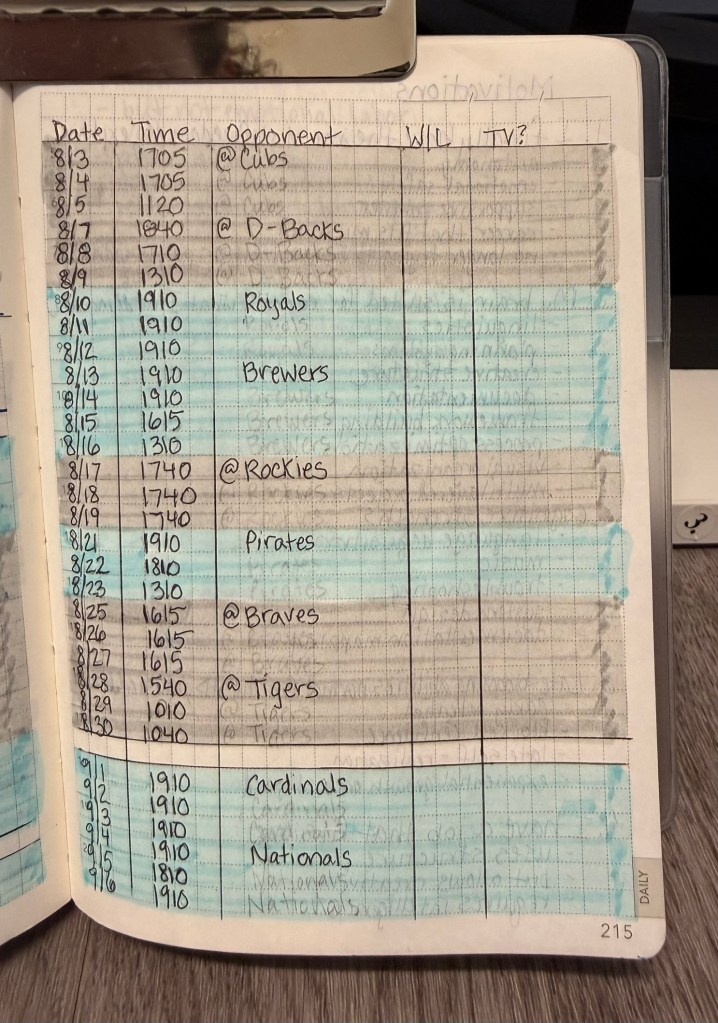
I dedicated an entire section of my 2026 planner to my team. I wrote out the schedule, where I keep track of wins and losses. I have a roster that I update when players are injured, sent down to AAA, called back up, etc.
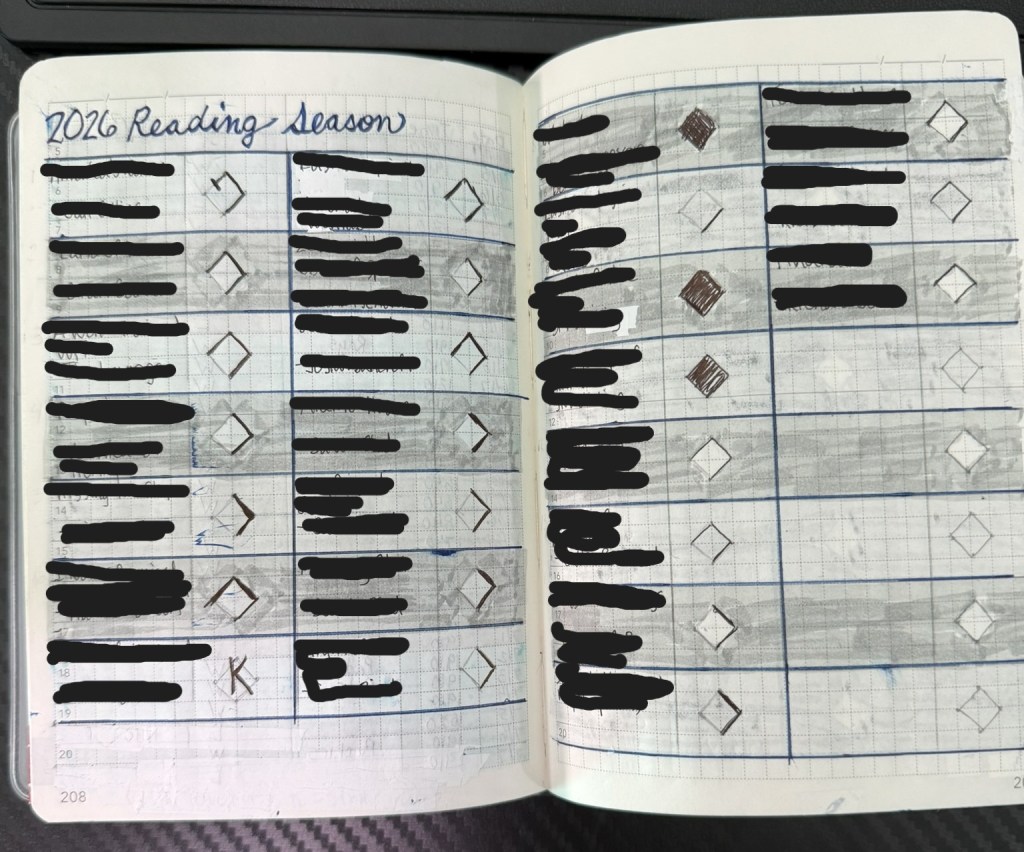
I even made a reading tracker that looks like a scorekeeper’s book: single = 1 star, double = 2 stars, and you can figure it out from there. I write a “K” — which signifies a strikeout — if I hated the book but finished it anyway.
I am sorry to say I have few home runs this year, but several strikeouts.
But that’s the game.
And apparently, there is no crying in baseball!
As you can see, I was entirely too heavy-handed with the mildliners…
One of the things I’ve realized this year is that I don’t really collect hobbies.
From the outside, it probably looks like I bounce from one thing to another. Gardening. Bookbinding. Norwegian. Citation templates. Herbs. Cocktails. Ancient history.
They’re all over the place.
To me, though, they’re all the same hobby.
I like understanding how things work.
The garden has made that clearer than anything else. Before this year, companion planting was something I’d read about. Soil composition was something I’d heard people discuss. Medicinal herbs were mostly names in books.
Now I get to watch it happen.
I’m seeing why one bed dries out faster than another. Why some plants seem happier next to certain neighbors. Which herbs attract pollinators and which ones don’t. Which vegetables struggle through a heat wave while others barely notice. It’s no longer just biology in a textbook. It’s biology happening in my backyard.
That’s probably why my garden is organized the way it is. It isn’t the most efficient layout, and I’ve certainly spent more time weeding because of it. But separating plants by water needs, companion planting, shade, and other variables lets me see what works and what doesn’t. I’m treating the garden as one giant experiment.
The same thing happens with my other projects.
I didn’t start making notebooks because I thought notebooks were too expensive. I started because I wanted to understand how books are made. Every mistake teaches me something, and every notebook gets a little better than the last.
I originally started learning Norwegian because I had a reason to. Somewhere along the way, though, the language became the reward. I enjoy the grammar, I enjoy listening to it, and I was ridiculously proud of myself for using it in Oslo, even if it was only a little.
The citation bundles might be the clearest example of all. I don’t enjoy formatting bibliographies. I enjoy solving problems, and I kept thinking about how much easier graduate school would have been if I’d had something like this on my desk.
Maybe that’s why all of these projects seem connected to me, even if they don’t to anyone else.
I think a lot of us are taught that life follows a fairly straightforward path: go to college right after high school, find a career, and work forty or more hours a week until retirement. I never really followed that plan, and for a long time I felt like I had somehow done life incorrectly.
As I have gotten older, though, I have realized that the things I didn’t do made me different in a way that I actually appreciate. I have always been curious, and I finally feel like I have given myself permission to simply learn things because they interest me.
So these days I find myself learning crafts, bookbinding, languages, gardening, and even some homesteading skills. There is always some new rabbit hole waiting to be explored.
Not always having steady work has certainly been stressful, but it has also taught me that life is about more than giving decades of yourself to an employer who may never appreciate you the way you deserve. There is value in creating things, learning things, and following your curiosity.
At this point, if something sounds interesting, I want to try it. Some people may think that is strange, and perhaps it is. But I enjoy it, and I like the idea of keeping my mind active and open to new experiences.
Maybe I am making up for lost time. Or maybe I am finally becoming the person I was always meant to be.
I used to see a lot of bullet journals on my personal Instagram account and thought they looked amazing. Design your own planner exactly the way you want? Sweet.
What I didn’t realize at the time was that there was an actual method attached to bullet journaling. I hadn’t done much research before trying it myself. I was mostly seeing beautiful spreads online — watercolor paintings, perfectly coordinated weekly layouts, intricate trackers, and pages that looked more like art books than planners.
Very quickly, I started to feel pressure to make mine look like that.
At first, I tried drawing every weekly and monthly spread ahead of time. I do not have the patience for that, so I switched to drawing one or two weeks at a time instead. Then I realized that if I wanted things like my book tracker in the back of the notebook, I would need to plan the entire notebook layout in advance anyway.
I tried using the actual Bullet Journal method at one point and discovered I hated how unfinished it felt. I wanted structure and consistency, not rapid logging and migration. I know that system works wonderfully for some people, but it didn’t work for me.
The Sticker Phase
While I was working on my computer science degree, I had an instructor who was very into planner culture. She showed me her A6 Wonderland222 planner and I immediately fell in love with it. I ordered one myself and quickly became overwhelmed by all the blank space.
This instructor was also very into a particular stationery and planner sticker shop, which I won’t name here because this is not criticism of that creator or her business. She gave me a small card with samples of washi tape, so naturally I visited the shop and bought a ton of things: weekly kits, monthly kits, decorative stickers, functional stickers…if it had cats, books, or cats with books, I bought it.
Then I found another shop and bought even more.
I hit the Black Friday sales hard. I ordered a Chinese New Year advent calendar and opened the entire thing all at once because I lacked the patience to wait.
As it turns out, many of these weekly kits are not designed for A6 planners at all. They are generally made for Hobonichi planners and similar Japanese formats. So I ended up with stickers overlapping into the next day, which drove me absolutely insane. At that point, I decided I hated my A6 planner and swore I would never buy one again.
Naturally, I decided to try bullet journaling again so I could use the stickers there instead.
That also did not work.
I tried using every sticker in the weekly kits because I felt like I needed to justify owning them. The result was cluttered, overwhelming, and honestly kind of ugly. I also experimented with a notebook that used black paper, which sounded cool in theory but quickly became impractical when I realized I couldn’t jot something down without finding a light-colored gel pen first.
The Hobonichi Cousin
After all of that, I bought a Hobonichi Cousin because everyone I followed online swore it was the perfect planner. I liked the idea of having monthly, weekly, and daily pages all in one place. When it arrived, I spent several hours assigning themes to each month and drawing a detailed book tracker in the back. I was ready.
And then I realized that system didn’t work for me either.
The daily pages felt like pressure. I barely touched the monthly spreads. I ignored most of the trackers. I disliked how few blank pages there were, and especially disliked what felt like wasted space: pages about preserving eyesight and address pages I knew I would never use.
People often say the printed ink is light enough that you can simply write over the daily pages if you want to repurpose them. In my experience, that wasn’t true at all. My handwriting competed visually with the printed quotes at the bottom of the page, and I found myself crossing out dates at the top just to make the pages usable.
Everything felt chaotic.
Returning to Structure
Eventually, I tried bullet journaling again — except this time, it slowly stopped being a planner altogether. Instead, it became a commonplace book. Looking back, that is probably what brought me back to keeping commonplace books in the first place.
Ironically, after all of this experimentation, I ended up returning to the A6 Wonderland222 planner.
Why Aesthetic Productivity Didn’t Work for Me
Over time, I realized that my aesthetic simply does not align with what people often associate with planner culture online. What I actually appreciate about the Wonderland222 is that it provides underlying structure without demanding that I use it in a particular way.
I eventually realized that I am creative, but only if there is some structure underneath everything.
For example, I turned some of the undated daily pages into a baseball section where I track my favorite team’s roster, wins and losses, and other notes throughout the season. I even designed my reading tracker to resemble a baseball scorekeeping book.
That creativity came much more naturally once I stopped trying to recreate what looked good online.
In the end, aesthetic productivity simply did not work for me, and that’s okay.
I don’t want organizing my life to feel performative. I’m minimalist by nature, and I eventually realized that I was spending more time trying to create the appearance of organization than actually building systems that supported my life.
At the same time, I know aesthetic productivity genuinely helps some people stay engaged and organized, and I’m glad they’ve found systems that work for them.
Because ultimately, that’s the point of a planner in the first place.
Baseball schedule – a bit messy, but beautiful to me! 🙂
There have been several studies showing that people tend to remember information better when they write it down by hand. For me, that has absolutely been true. Hence the ever-growing stack of commonplace books around my house.
One study discussed in Scientific American explains that typing involves repeating the same simple finger movements, while handwriting creates distinct physical motions for each letter. According to Audrey van der Meer, who spearheaded the study, handwriting helps lock the motor and sensory systems together.
I won’t get too deep into the science here. That isn’t my area of expertise. But looking back, I wish I had been able to handwrite more of my notes in law school.
I tried for a week or two. Eventually, though, the professors spoke too quickly for me to keep up effectively by hand. I switched to typing instead, organizing everything neatly in OneNote by class, with individual pages for each topic on the syllabus. My organization system was solid. The problem was retention.
I’m also not the type of person who can compulsively reread notes over and over again. That makes it especially important for me to absorb the material the first time I encounter it, and handwriting seems to help with that.
In high school, we had spelling tests where we memorized vocabulary terms alongside their definitions. During the test, we had to fill in the correct word next to each definition. Because I had physically written the words down beforehand, I could often close my eyes and “see” the page in my head. Even if I couldn’t immediately remember the correct word, I could remember where it had been positioned relative to the others on the list.
That kind of visual and physical memory still seems to matter for me now.
At any rate, I love creating these various and often random commonplace books. I don’t have to learn at someone else’s speed. I can sketch diagrams where needed. I can reorganize information however my brain naturally wants to process it. For me, it’s simply a better system.
The funny thing is that I never really learned how to study. As a child, most schoolwork came easily to me, so no one ever thought I might need actual study strategies later on.
Over the years, I have Googled and browsed Pinterest trying to find the “best” note-taking system. One method that appears constantly is the Cornell Method, where the page is divided into three sections: a narrow left-hand “cue” column for keywords or questions, a larger note-taking section on the right, and a summary section at the bottom.
I tried it a couple of times and never found it especially helpful. Even the research surrounding the method seems somewhat inconclusive.
What I eventually realized is that I don’t need an elaborate system.
I just need something straightforward that works with the way my brain already processes information: plain notebooks, handwritten notes, and room to think.
No fancy handwriting. No planner stickers. Just paper.
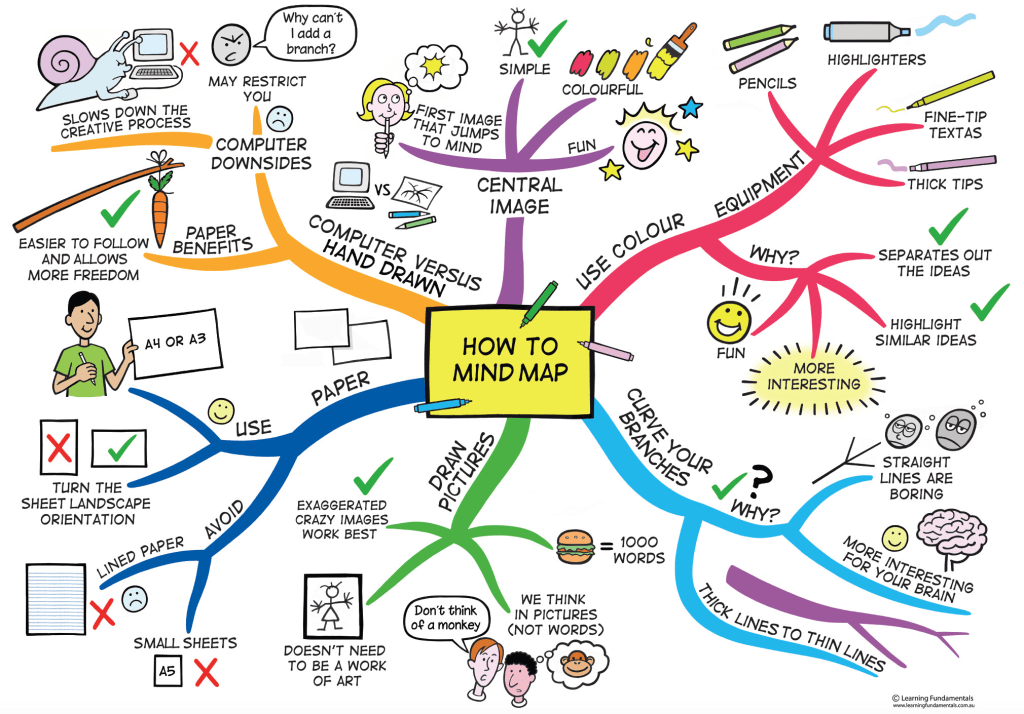
And yes, I once asked ChatGPT for note-taking advice. It suggested mind maps.
I practically yelled at the screen.
They look so chaotic to me that I know I would immediately become irritated with my own notes and never look at them again.
I don’t have any pictures to share yet, but I have been building a commonplace book for this endeavor. I have sections for gardening, recipes, and crafts. I have a separate one for learning Gaelic, so that is not included here. So far, I have a monthly task list for my garden (which I included because those are the ingredients I’ll be using in many of my recipes) and a vegan bannock recipe. One of these days, I will post photos, but right now I am shy about how messy it is. Which shouldn’t be a barrier, but it can take me a while to feel comfortable with that.
I was going to highlight the sides of the pages in the colors I chose for the sections, but I quickly realized that won’t work if I have, say, one page of garden plans and then one page of recipes, and so on. No one would be able to see the differentiation. I will likely try washi tape next, even though the thought of putting a strip of washi tape on every page sounds tedious. If anyone has any suggestions, I would love to hear them.
I do struggle with boring pages…there are people out there who are amazing artists and I love that they share that with the rest of us. I do not expect my pages to look like that, but I grow tired of just writing linearly down the page. So with my monthly garden tasks, I at least color-coded the months to break up the monotony. I also drew a couple strands of wheat on the bannock page and included a quote regarding bannocks by Robert Burns. That’s about the best I can come up with right now, but I am happy the pages are more interesting now.
I’m currently using an Amazon Basics grid notebook. I have TONS of notebooks and I have to use them before I can justify buying more. I find the grids difficult to use though, because they are visually loud, and the substance of my information can get lost. I have decided that the next time I need a notebook, I will buy A5 paper and print out dotted pages. After that, I will bind them. This need became apparent when I was looking for notebooks with more pages; I found many with 50-100 sheets, but I’m looking for 200+ sheets (not pages). I don’t want dozens of books hiding around the house. As it stands, I have a few old planners, an old commonplace book, two black paper journals that I found near impossible to use, several notebooks of certification studying, etc. I don’t mind having a separate notebook for something like a network security certification, but I don’t need four of them to talk about one thing.
Ugh, I just remembered the 8 brand-new engineering pads I bought before I changed my major to computer science.
I have dedicated a commonplace book to this topic, in order to have everything in one place. So far, it is divided into: gardening plans, 18th century history, and recipes.
Here are some steps you can try:
Tip #1 – Figure out what aspect of Highland culture you’d like to dig into
Do you like history? Food? How to wear various types of tartans? All of the above?
Tip #2 – Find a way to organize your notes and thoughts
I like to keep as much as possible analog; I find that the act of writing things down helps me remember. I have also used my bujo, but the bujo fills up quickly and I don’t care to make a new one every month. Digital note-taking apps are available as well: Goodnotes, Microsoft OneNote, Evernote, and Notion, among others. I haven’t found one that works for me, but use whatever you need to to keep everything straight.
There is scarcely anything to which I am so feelingly alive as the honour and welfare of my country, and, as a poet, I have no higher enjoyment than singing her sons and daughters.
After finding out what you need, and getting all of it, try it out! If you want to crochet or knit, there are sites with free Outlander patterns (if that’s what you are looking for, otherwise there are free patterns all over). If you want to cook, there are plenty of Scottish recipe sites, both vegan and non-vegan. The best way to improve at something is to just do it.
This last tip is purely optional; I know I have trouble showing people anything I am working on, though I can share my cooking results with my spouse at any time. Even if it looks weird.
Make this project work for you!
If you want to research and/or just enjoy Highland culture, do what makes you happy in the way that makes you happy. And feel free to contact me, whether you have a question, want to share something you made, or just want to express your thoughts.