The Bullet Journal Rabbit Hole
I used to see a lot of bullet journals on my personal Instagram account and thought they looked amazing. Design your own planner exactly the way you want? Sweet.
What I didn’t realize at the time was that there was an actual method attached to bullet journaling. I hadn’t done much research before trying it myself. I was mostly seeing beautiful spreads online — watercolor paintings, perfectly coordinated weekly layouts, intricate trackers, and pages that looked more like art books than planners.
Very quickly, I started to feel pressure to make mine look like that.
At first, I tried drawing every weekly and monthly spread ahead of time. I do not have the patience for that, so I switched to drawing one or two weeks at a time instead. Then I realized that if I wanted things like my book tracker in the back of the notebook, I would need to plan the entire notebook layout in advance anyway.
I tried using the actual Bullet Journal method at one point and discovered I hated how unfinished it felt. I wanted structure and consistency, not rapid logging and migration. I know that system works wonderfully for some people, but it didn’t work for me.
The Sticker Phase
While I was working on my computer science degree, I had an instructor who was very into planner culture. She showed me her A6 Wonderland222 planner and I immediately fell in love with it. I ordered one myself and quickly became overwhelmed by all the blank space.
This instructor was also very into a particular stationery and planner sticker shop, which I won’t name here because this is not criticism of that creator or her business. She gave me a small card with samples of washi tape, so naturally I visited the shop and bought a ton of things: weekly kits, monthly kits, decorative stickers, functional stickers…if it had cats, books, or cats with books, I bought it.
Then I found another shop and bought even more.
I hit the Black Friday sales hard. I ordered a Chinese New Year advent calendar and opened the entire thing all at once because I lacked the patience to wait.
As it turns out, many of these weekly kits are not designed for A6 planners at all. They are generally made for Hobonichi planners and similar Japanese formats. So I ended up with stickers overlapping into the next day, which drove me absolutely insane. At that point, I decided I hated my A6 planner and swore I would never buy one again.
Naturally, I decided to try bullet journaling again so I could use the stickers there instead.
That also did not work.
I tried using every sticker in the weekly kits because I felt like I needed to justify owning them. The result was cluttered, overwhelming, and honestly kind of ugly. I also experimented with a notebook that used black paper, which sounded cool in theory but quickly became impractical when I realized I couldn’t jot something down without finding a light-colored gel pen first.
The Hobonichi Cousin
After all of that, I bought a Hobonichi Cousin because everyone I followed online swore it was the perfect planner. I liked the idea of having monthly, weekly, and daily pages all in one place. When it arrived, I spent several hours assigning themes to each month and drawing a detailed book tracker in the back. I was ready.
And then I realized that system didn’t work for me either.
The daily pages felt like pressure. I barely touched the monthly spreads. I ignored most of the trackers. I disliked how few blank pages there were, and especially disliked what felt like wasted space: pages about preserving eyesight and address pages I knew I would never use.
People often say the printed ink is light enough that you can simply write over the daily pages if you want to repurpose them. In my experience, that wasn’t true at all. My handwriting competed visually with the printed quotes at the bottom of the page, and I found myself crossing out dates at the top just to make the pages usable.
Everything felt chaotic.
Returning to Structure
Eventually, I tried bullet journaling again — except this time, it slowly stopped being a planner altogether. Instead, it became a commonplace book. Looking back, that is probably what brought me back to keeping commonplace books in the first place.
Ironically, after all of this experimentation, I ended up returning to the A6 Wonderland222 planner.
Why Aesthetic Productivity Didn’t Work for Me
Over time, I realized that my aesthetic simply does not align with what people often associate with planner culture online. What I actually appreciate about the Wonderland222 is that it provides underlying structure without demanding that I use it in a particular way.
I eventually realized that I am creative, but only if there is some structure underneath everything.
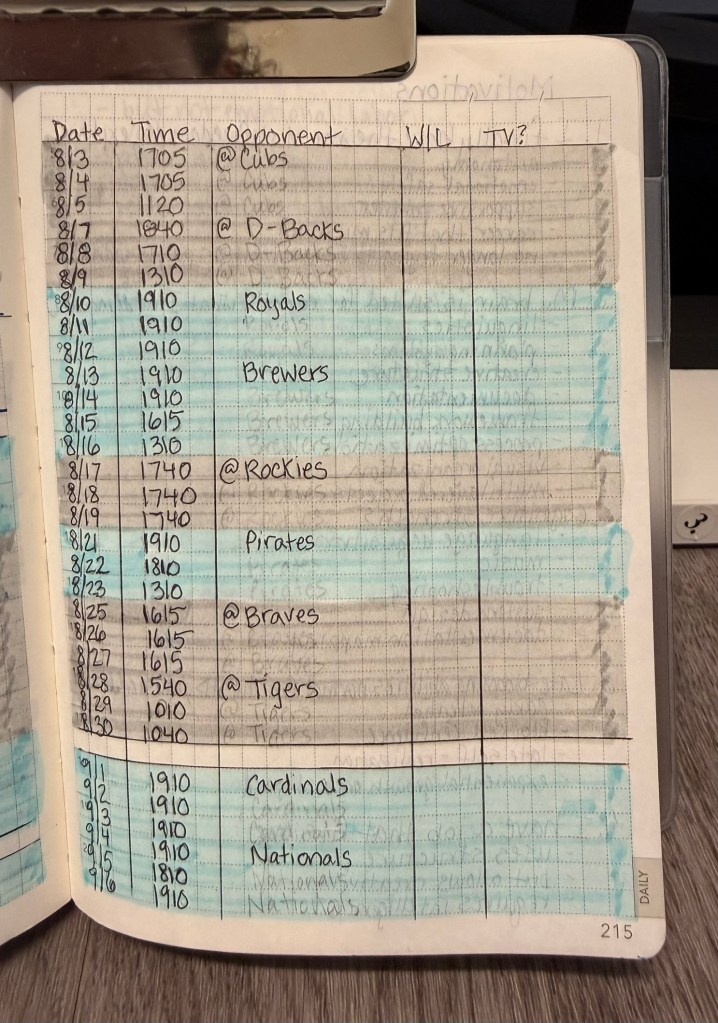
For example, I turned some of the undated daily pages into a baseball section where I track my favorite team’s roster, wins and losses, and other notes throughout the season. I even designed my reading tracker to resemble a baseball scorekeeping book.
That creativity came much more naturally once I stopped trying to recreate what looked good online.
In the end, aesthetic productivity simply did not work for me, and that’s okay.
I don’t want organizing my life to feel performative. I’m minimalist by nature, and I eventually realized that I was spending more time trying to create the appearance of organization than actually building systems that supported my life.
At the same time, I know aesthetic productivity genuinely helps some people stay engaged and organized, and I’m glad they’ve found systems that work for them.
Because ultimately, that’s the point of a planner in the first place.