I was at a loss the other night trying to figure out dinner. I had originally planned spaghetti, but we had spent most of the day loading and unloading wood, furniture, etc., so the thought of hot food was not appealing.
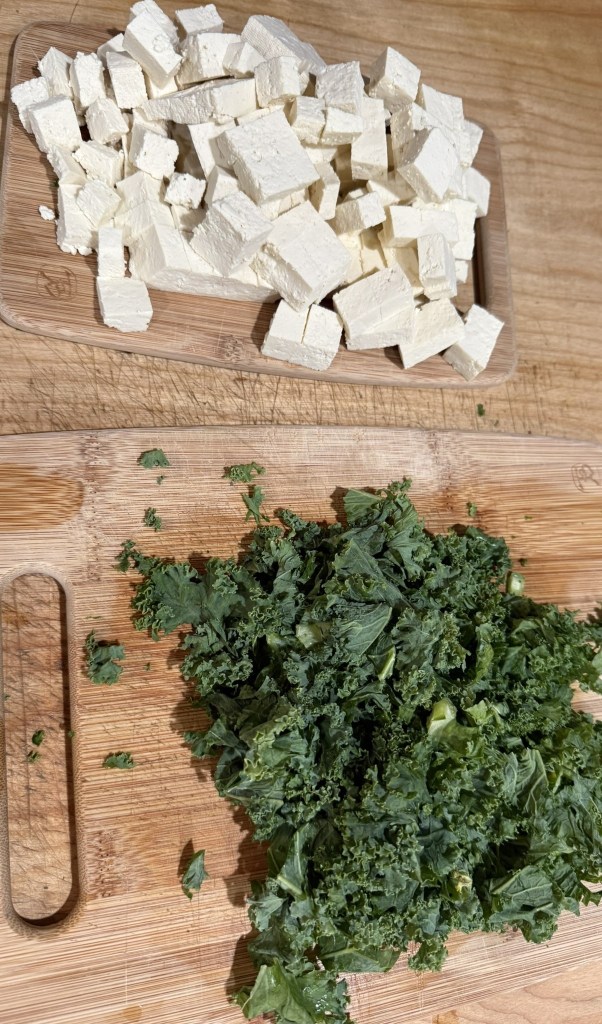
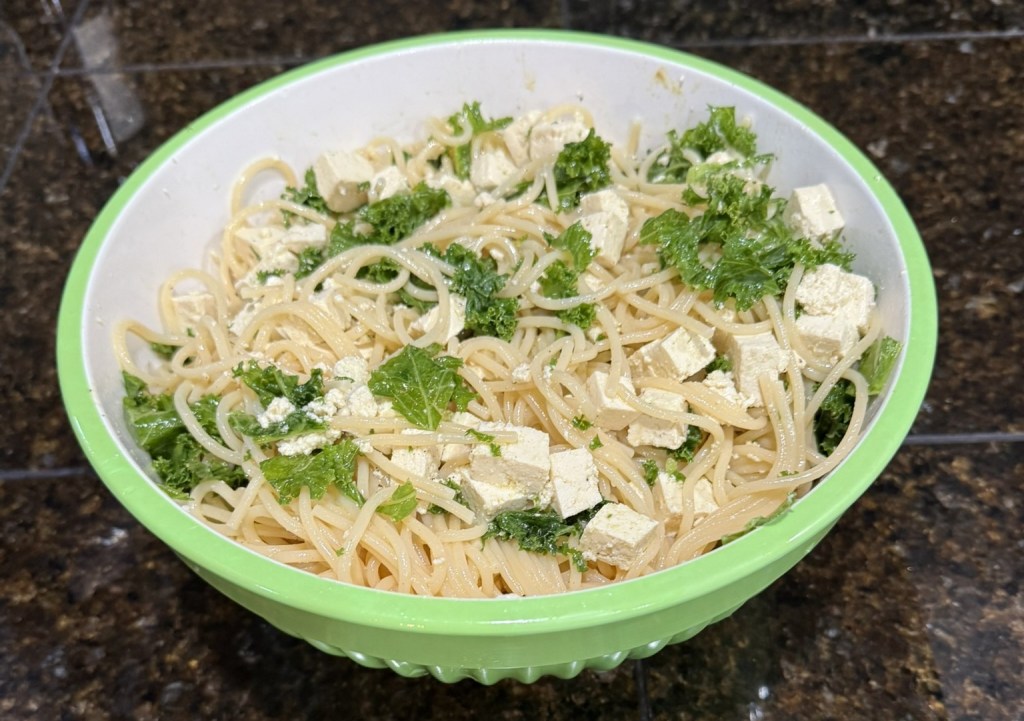
Pasta still sounded good, though, so I looked through my pantry to see what we had lying around. I ended up making cold spaghetti noodles, then added olive oil, red wine vinegar, a bit of Dijon mustard, granulated garlic powder, salt, and black pepper. I was going to add dried basil, but I forgot. Next, I added some chopped kale and some tofu, then mixed everything together.
It turned out to be quite delicious! I usually end up not putting enough oil in dishes like this, which makes them rather flavorless the next day. But I had pretty good proportions this time.
Spouse was happy, I was happy, and dinner was taken care of without heating up the kitchen any more than necessary.
Since I made this up as I went along, I didn’t measure anything. But I’ve put together an approximate recipe below. Feel free to adjust the dressing to your own taste!
½ teaspoon dried basil (optional, and only if you remember it!)
Instructions
Cook the spaghetti according to the package directions.
Drain and rinse under cold running water until the noodles are completely cooled.
In a small bowl, whisk together the olive oil, red wine vinegar, Dijon mustard, garlic, salt, and pepper.
Place the cooled spaghetti in a large bowl. Add the chopped kale and cubed tofu.
Pour the dressing over everything and toss until thoroughly coated.
Taste and adjust the seasonings. Add more olive oil or vinegar if needed.
Serve immediately or refrigerate until ready to eat.
Notes: This is a very forgiving recipe. The dressing quantities are approximate, so start with the suggested amounts and adjust according to your preferences. If you’re planning to have leftovers, you may want to add a little extra dressing before serving, since pasta tends to absorb it as it sits.
I have hit a bit of a creative wall lately. I have approximately 9,000 things I want to make, write, cook, bind, grow, or otherwise obsess over, and somehow that has translated into…doing very little.
So naturally, I have found myself a new project.
Before I was vegan, there were a lot of foods in New Orleans that I loved. Mostly beignets. I could have eaten beignets all day.
Unfortunately, Café du Monde is not particularly concerned with my vegan beignet needs.
The same goes for pralines. I used to have a favorite praline company, and their entire philosophy appears to be, “What if butter, but more?”
So now I want to see how many of my old favorites I can recreate without making them quite so dependent on dairy.
Gumbo should be easy enough. I used to make a pretty good one, and since I have always hated seafood and shellfish, I was already halfway there.
Beignets are the one I really want to tackle. Vegan donuts exist, of course, but nobody around here is making vegan beignets—and frankly, I am not looking for a donut covered in cereal, bacon, or twelve other things that have absolutely no business being on a donut.
I just want fried dough covered in an irresponsible amount of powdered sugar.
So that’s the next experiment.
Hopefully, in the coming days, I will have some new recipes to share—and, assuming I remember to stop eating long enough to take them, some decent photos of the process.
I bought cashews months ago because I wanted to make cheese. My favorite cheesemaker was ousted from her own company and they’ve decided just to stick to basic cheese spreads and butter.
Just here for the recipe? Scroll down to “The Recipe.”
So why not make my own?
I took a basic recipe I found and added my own little twists along the way. First, I boiled the cashews for 20 minutes because I was too impatient to soak overnight.
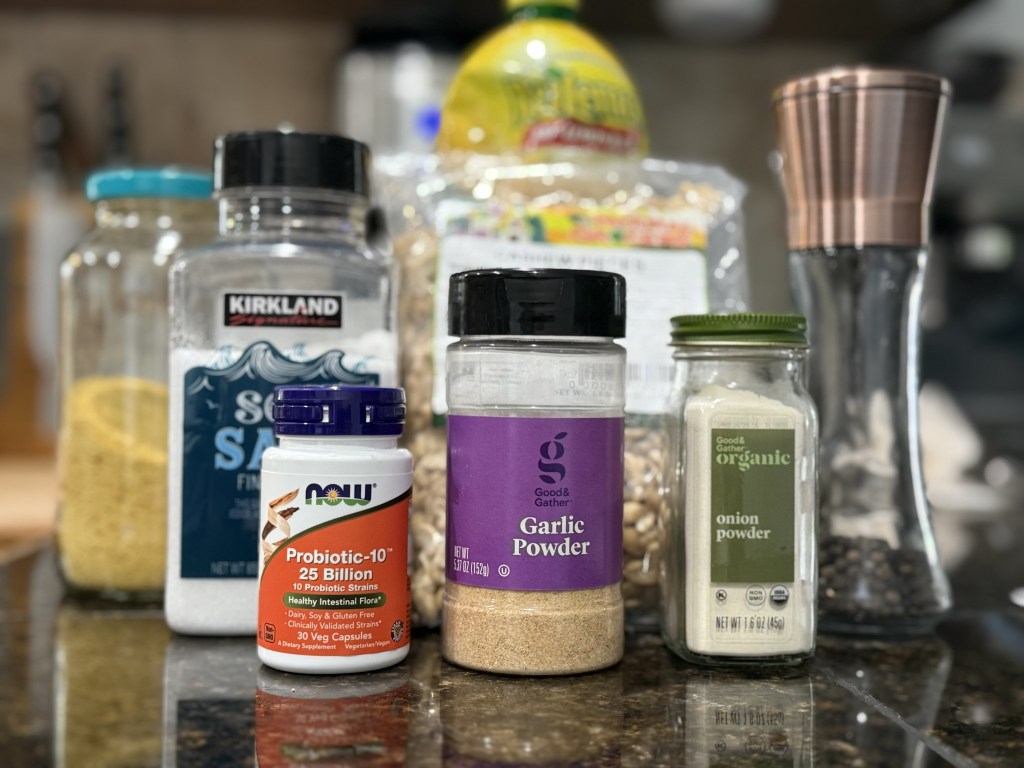
Then I got out the trusty Vitamix and got to work. The cashews went in, then some nutritional yeast, garlic powder, and onion powder. I blended it until it was smooth and then added the insides of two probiotic pills (I don’t recommend putting the whole pill in there…I feel like it wouldn’t end well).
After adding the probiotics, I blended just a little. For a reason I don’t know yet, you don’t want to blend those in too much.
It took forever to scrape out the cheese mix, but I finally got it into a cheesecloth-lined strainer, which was then laid over a bowl. Since I have cats, I put the bowl into a cabinet and set a reminder to check it in 20 hours, since my house tends to be pretty warm.
Twenty hours later, I tasted it. It still tasted a lot like nutritional yeast, so I left it for a few more hours. It could have fermented longer but again, since my house is warm, I decided my first attempt could be a milder cheese.
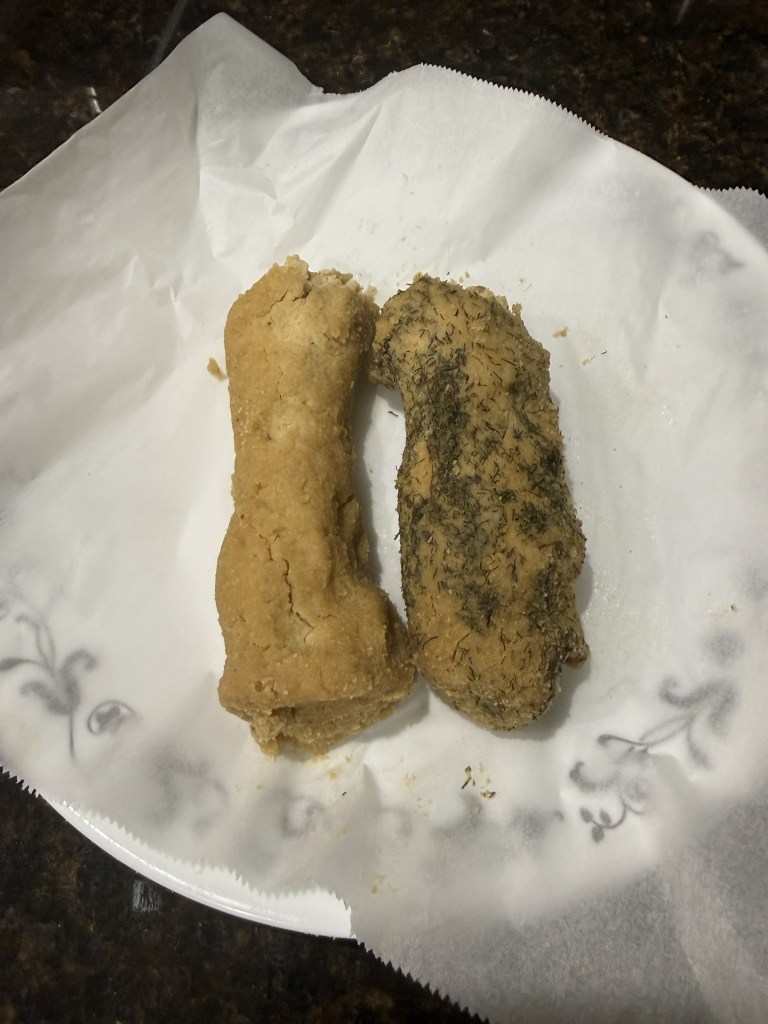
I divided the cheese in half so I could make one regular and one with an herb crust. I rolled both into a log (it was so sticky…), then rolled one through a layer of dill (unfortunately not dill I grew myself, but hey, I can’t do everything). Finally, I laid the logs on a piece of parchment paper laying on a plate and stuck it in the back of the fridge.
Five days later…
I was nervous.
It smelled amazing, but until I actually took a bite, I wasn’t convinced I’d made anything that tasted remotely like cheese…or even anything edible. I’d also somehow managed to shape the logs into something that looked like my very first Play-Doh project from kindergarten.
But it was good.
Really good.
Final Thoughts
The household approved both versions, but the dill-coated cheese won. Next time: longer fermentation, white miso, and significantly better-looking logs.
The dill-coated cheese was my favorite. And even better…the household liked both.
Ready to make your own?
The Recipe
This is the recipe I used for my first successful batch. I already have a few ideas for improving it, but it turned out well enough that I’m writing it down before I inevitably start tinkering.
Soak: soak cashers 4-8 hours or boil 20 minutes. Drain and rinse.
Blend: Blend cashews with nutritional yeast, lemon juice, salt, optional garlic and onion powders, and 2 tbsp water until very smooth and thick. Add a little more water only if needed.
Add probiotics: Open capsules and stir or briefly pulse into the mixture. Do not blend for long after adding them.
Ferment: Line a strainer with cheesecloth over a bowl. Transfer mixture, cover loosely, and leave at room temperature for 24-48 hours. Taste after 24 hours; ferment longer for more tang.
Shape: Form into a wheel or log and roll in herbs or spices if desired.
Age: Refrigerate uncovered or loosely covered on parchment or a rack. Flip daily. 3 days = soft and sliceable; 5-7 days = firmer; 10-14 days = tangier and more aged.
Storage:
Refrigerate in an airtight container after aging. Best within 1-2 weeks. Freeze up to 3 months.
Serving Ideas:
Crackers, toasted sourdough, sandwiches, wraps, salads, stuffed mushrooms or peppers, bagels, or a vegan charcuterie board.
Lessons Learned
The next time I make it, I’ll let it ferment a little longer for a tangier flavor and figure out a better way to shape the logs (the preferred shape in this house). I’d also like to pick up some white miso, which is a common ingredient in cultured cashew cheese and should add even more depth. Eventually, I’m going to try recreating the volcanic ash cheese the household misses.
For a first attempt, though, I’m calling this one a success. Homemade vegan cheese has officially joined the list of things I never expected to make…right alongside growing my own herbs, saving seeds, and making infused oils.
I won’t do the thing where you have to scroll past three pages about how my family has used this recipe for six generations and built an empire from it.
But I still have to explain how I got here, so bear with me…
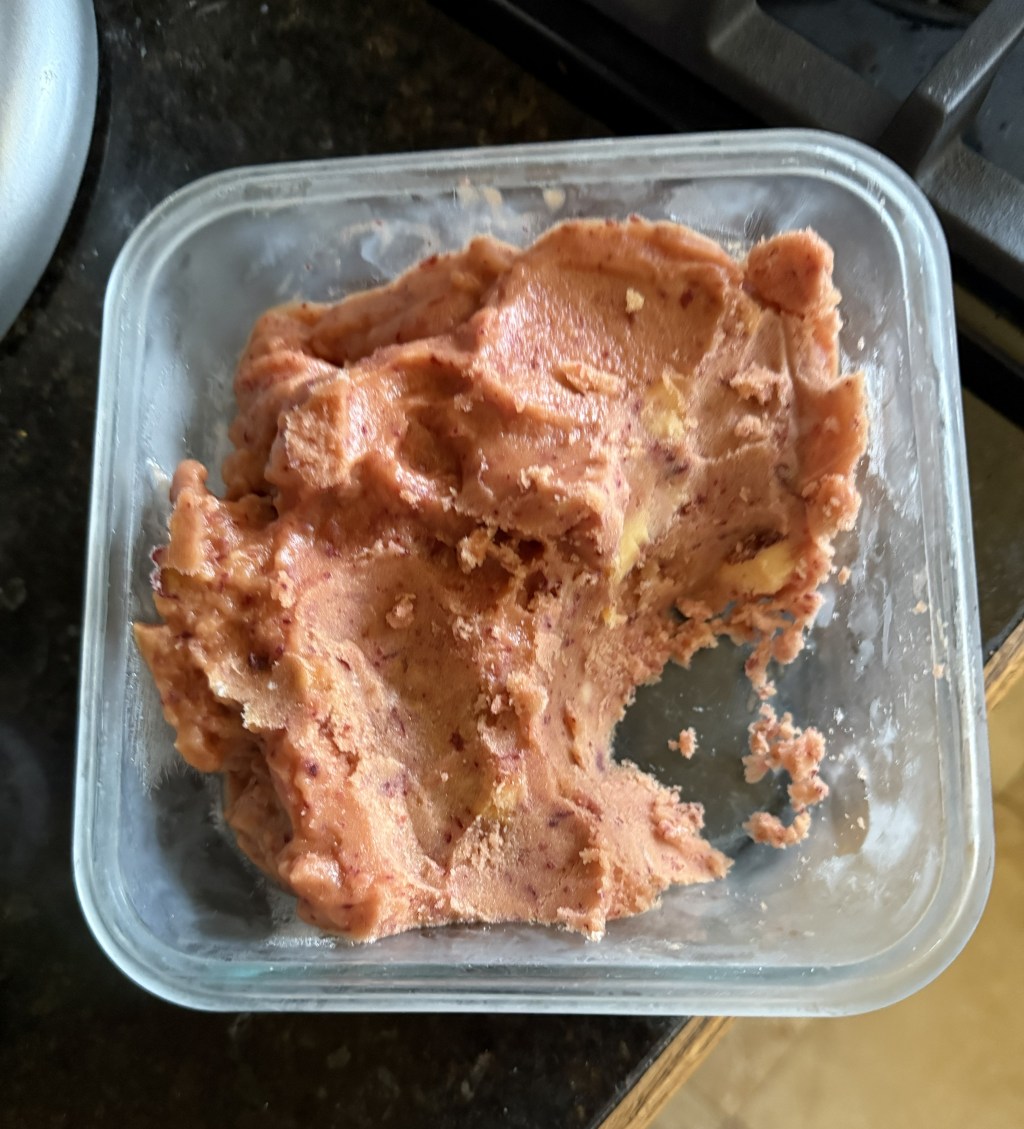
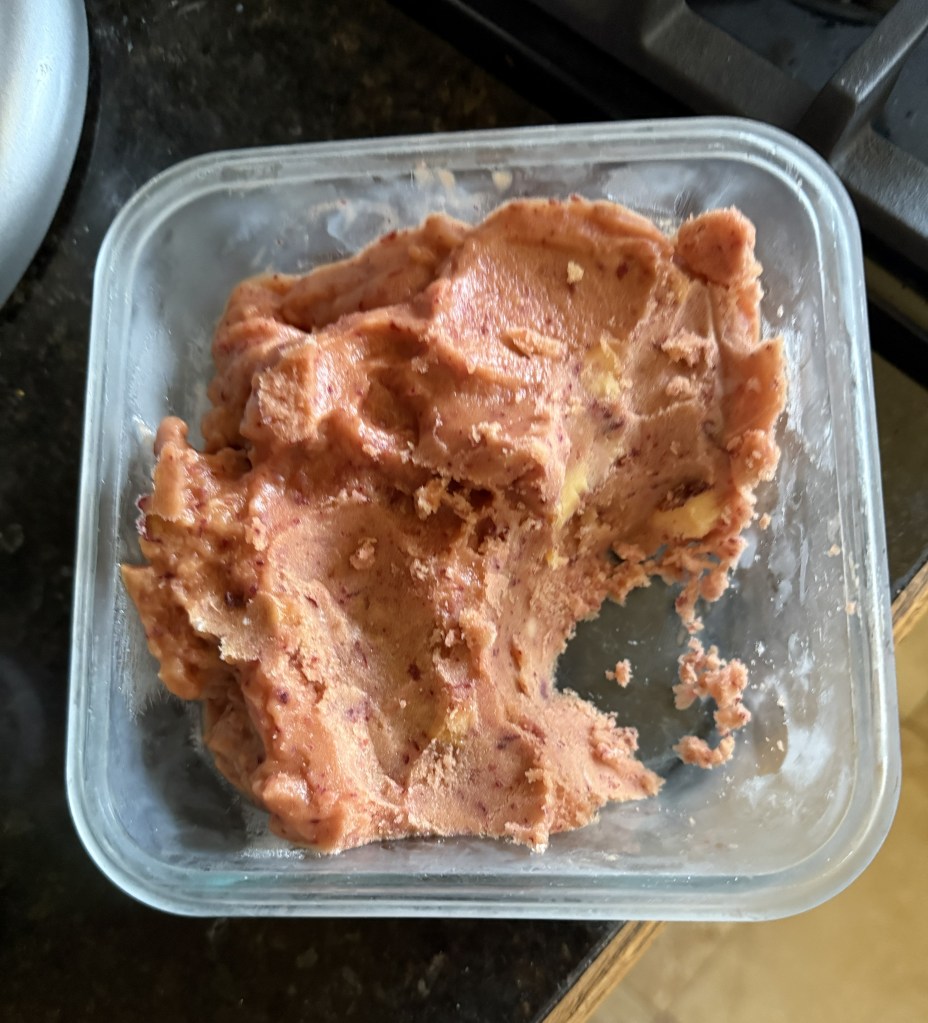
I had four peaches that were getting way too soft, and I wasn’t about to let them go to waste. So I tossed them in the freezer and decided to make peach nice cream in my Vitamix.
It turned out so much better than I expected. It’s creamy, refreshing, ridiculously easy, and perfect for using up fruit that’s on its last leg.
Ingredients
3-4 ripe peaches, peeled (if you want), sliced, and frozen
1/4-1/2 cup plant milk (I used almond milk)
1-2 tbsp maple syrup, sugar, or agave (I used agave, but the sweetener is optional)
1 tsp vanilla extract
Tiny pinch of salt
Instructions
Add the plant milk to the Vitamix first.
Add the frozen peaches.
Add the vanilla, sweetener, and salt.
Insert the tamper (using the lid, of course!).
Start on Variable 1, quickly increase to Variable 10, then switch to High. If your Vitamix has an Ice Cream program, you can use that instead.
Use the tamper continuously to push the peaches into the blades while blending.
Blend for 30-60 seconds until the mixture resembles soft serve. If it’s too thick, add more plant milk one tablespoon at a time.
Note: I actually blended mine for several 30-60 second cycles because I wanted it extra thick.
Transfer the nice cream to a freezer-safe container and freeze for 2-3 hours before serving.
Enjoy!
And if you happen to have millions of peaches instead of four, I suppose you could just make a bigger batch.
Right now, I’m drying several kinds of herbs—some for cooking and others for future tinctures and infused oils. The problem is that I’ve officially run out of space.
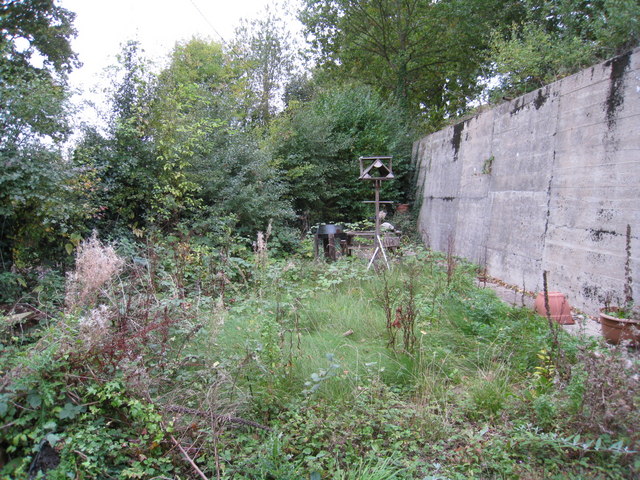
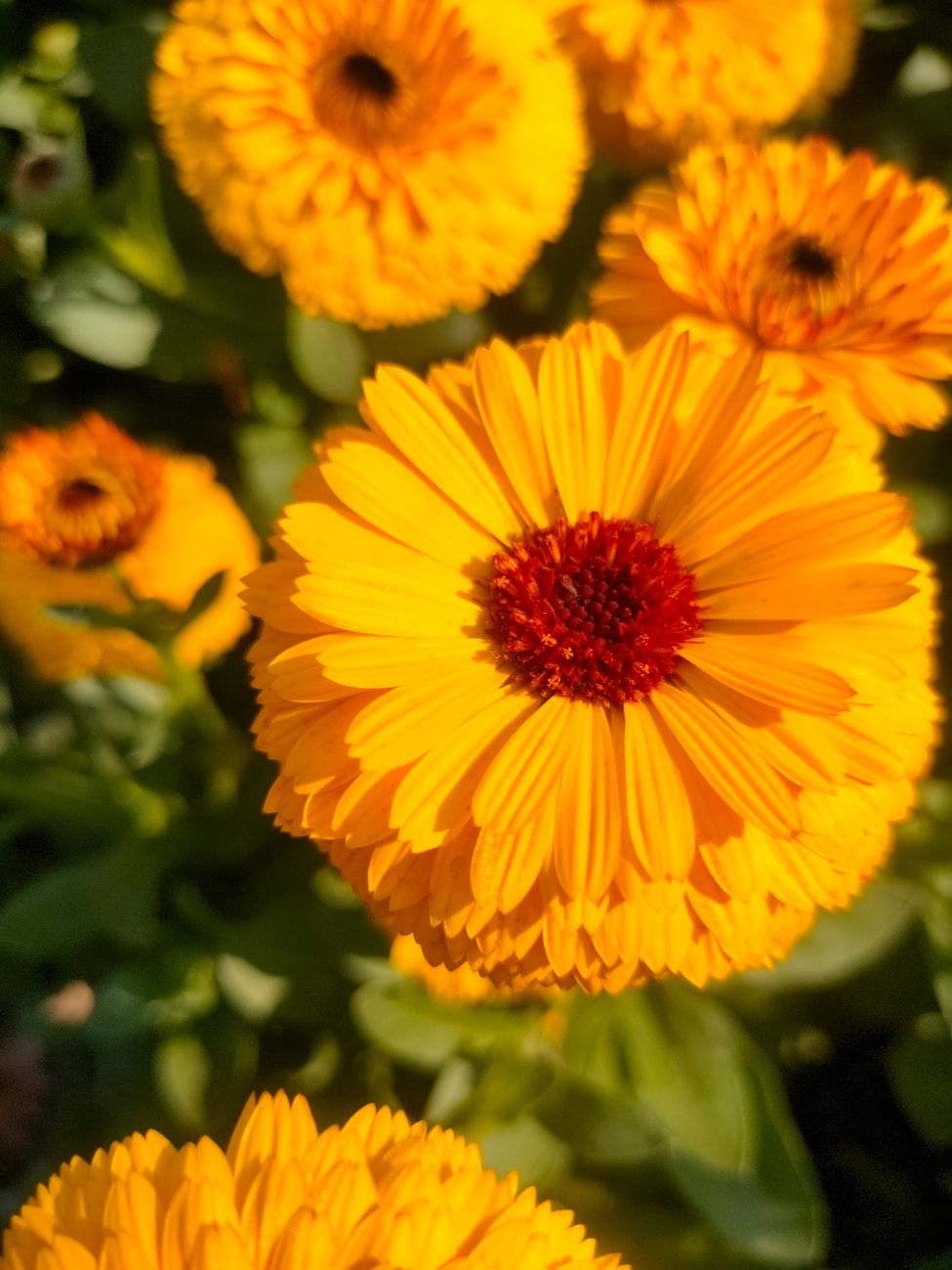
One thing I’m especially excited about is that I was finally able to harvest calendula seeds. This is my second year growing them, and it’s the first time I’ve managed to collect seeds from my own plants. There’s something incredibly satisfying about knowing next year’s flowers can come from this year’s garden.
The top of the bookshelf in my office is covered with plates and coffee filters full of drying herbs. As one batch finishes, I jar it up and replace it with another. There’s even a bundle of lavender hanging from a wall-mounted desk organizer.
Storage has become its own project. My herb cabinet is such a disaster that I don’t want to mix the new harvest with the old, so the culinary herbs have taken over a different cabinet. The calendula-infused oil lives there too, and once I bottle it, those bottles will need a home as well.
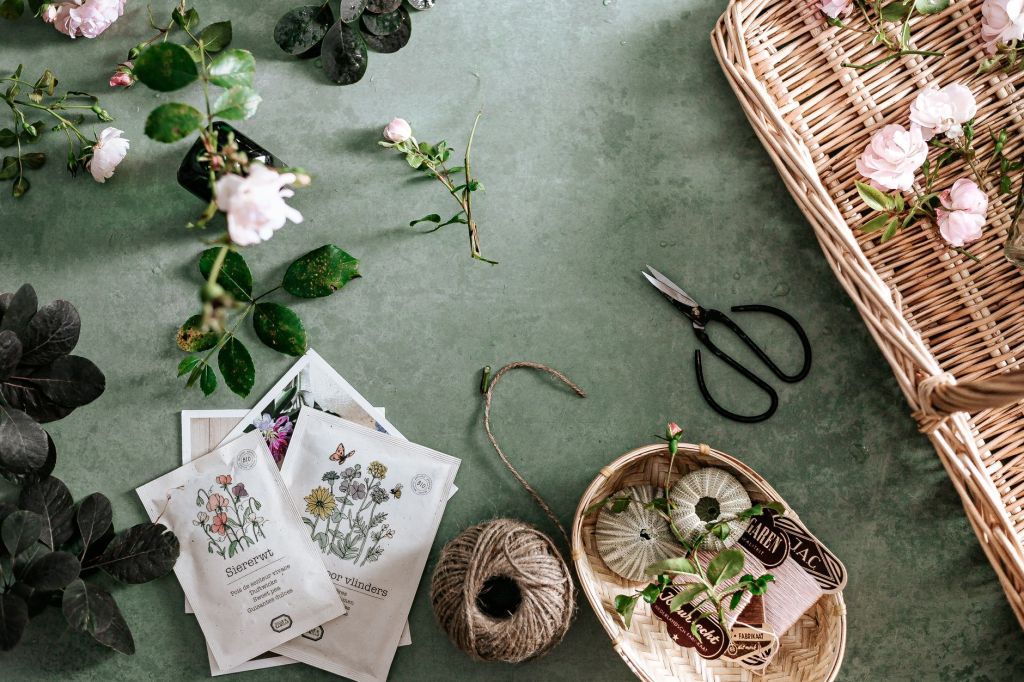
I’m also pressing flowers. Since I don’t own a flower press, I’m improvising with paper, a storage container, and a very heavy book balanced on top. That setup currently lives on another bookshelf.
Eventually, I’d like my Etsy shop to carry physical products, which means I’ll have to rethink the entire room. So far, my best idea is turning an old slatted bookshelf support into a drying rack for herb bundles. Beyond that, I’m still figuring it out.
And don’t even get me started on next year’s seedlings. Apparently my cat decided this year’s starts made an excellent lunch, so I’ll need to find a much safer location.
I’m certainly not complaining—having more herbs than I know where to put is a pretty good problem to have, especially while I wait for the tomatoes to ripen. But wow…everything needs a permanent home.
The garden compendium was originally meant to be a catch-all. It included medicinal herbs with drawings, uses, and recipes; planting, care, and harvest instructions for all of the herbs and vegetables I planted; a diagram of this year’s layout; a planting calendar; and a journal of what I did, what happened, and how I could fix my mistakes.
That plan hasn’t changed. The notebook will continue into next year, or however long it takes me to fill 300 sheets.
What has changed is everything else.
Originally, I wrote herb recipes on the back of each herb page. It didn’t take long to realize that a tincture is a tincture, my handwriting was getting messier, and my fountain pen was ghosting through onto the drawing on the other side. So the recipes are getting their own section, but only for the preparations I’ve actually made with herbs from my own garden. The herb pages themselves will stay as a high-level overview with drawings and uses.
Then there are the medicinal herbs.
I have become fascinated by them and have been researching them like crazy. That rabbit hole is deep enough to fill 300 sheets all by itself, which wasn’t the original purpose of the compendium. I wanted this notebook to be something I could leave behind someday—a record of the garden that my descendants could flip through and (hopefully) ooh and ahhh over.
So, naturally, I’m making another notebook.
Medicinal herbs deserve one of their own. The subject is practically endless, and if you’ve been reading my blog for any length of time, you’ve probably noticed that I’m incapable of leaving well enough alone.
I’ve also started color-coding the page edges. The notebook only came with two ribbon bookmarks, which isn’t nearly enough anymore. By highlighting the edges of each page based on the section—herbs, vegetables, diagrams, journal entries, and so on—I can find what I’m looking for without even opening the book.
And finally…
I did the one thing I swore I wasn’t going to do.
I started an Excel workbook to track planting and care information for vegetables I haven’t even decided if I’m going to grow yet.
No matter how much research I did before planting my garden (and I’m certainly not finished), there were still plenty of surprises. Some things completely failed, while others did far better than I ever imagined.
I organized my garden into separate beds based on companion planting, water needs, soil type, and a handful of other factors. It definitely created more weeding than I would have liked, but I needed to see what worked and what didn’t.
In some beds, none of it seemed to matter. I planted starts at the right time, paired them with their companion plants, and they promptly died. I direct sowed whatever I could, and sometimes nothing came up at all. I even moved some of those stubborn plants into bins with fresh potting soil. A few are thriving, while others are either refusing to grow or have become an all-you-can-eat buffet for whatever animal keeps digging them up.
Then there are the pleasant surprises.
The borage is so big that I’m honestly not sure what to do with all of it. I’ll keep tossing the flowers into salads, and the rest will probably go to seed. It’s one of the best bee attractors in the garden, though, so it’s earned its place. It also doesn’t hurt that it’s gorgeous.
The calendula is massive. I’m drying flower heads for a future tincture, chamomile for tea, and I have dill coming out of my ears. The lettuce just keeps producing, and the carrots have done far better than I expected.
All that being said, the garden has been a fruitful learning experience. (Fruitful. Get it?)
As the season goes on, I’m no longer fighting the garden. I’m letting it show me what works, what doesn’t, and how I can make next year’s garden even better.
And as the universe is my witness, I will not let the quince from hell win.
Recently, the fam and I took a trip to Southern California to ride some roller coasters. Before we even left, we knew the main park had two restaurants with Beyond burgers. At this point, that’s pretty much what we’ve come to expect.
I was actually excited that one of those restaurants was Johnny Rockets. The location I went to in Vegas had a full vegan burger, so I figured this one would be similar.
Nope.
The park version was a Beyond patty on a bun. No cheese. No sauce. Just a dry burger and a handful of ketchup packets. Like a lot of amusement park “vegan” options, it was…fine. We weren’t hungry anymore, and that’s about the best thing I can say about it.
The water park was even worse. They stopped selling the Beyond burger there about a year ago, so our options were basically pretzels or chips. We figured we’d grab some fruit instead, except the fruit cup at the main park came topped with whipped cream. Apparently, even fruit isn’t a safe bet.
We rented a cabana, which came with its own menu, and decided to order the fruit platter. About an hour later, our $36 fruit platter arrived.
It was a plastic clamshell full of moldy purple grapes.
That was it.
By the time I added the margarita I’d ordered, we’d spent almost $60 on moldy grapes and a drink that may or may not have contained alcohol.
Unfortunately, this isn’t unusual. Disney World had a lot more vegan options than Magic Mountain, but “more options” doesn’t necessarily mean “better food.” We had vegan sausages in two different places that were so dry they somehow made the amusement park burgers seem moist.
The biggest lesson we’ve learned from traveling as vegans is simple: bring your own food whenever you can.
On our second day, we packed sandwiches, left the park for lunch, and honestly enjoyed them far more than anything we’d bought inside. They were healthier, tasted better, and cost a fraction of the price.
Thankfully, the trip ended on a much better note.
On our last night, we found a local restaurant with an entirely separate vegan menu—not just a Beyond burger with the cheese removed. They had loaded fries, buffalo tots, and the best vegan Philly cheesesteak I’ve ever had. Honestly, it was one of the best meals I’ve had, period, and I’m not usually someone who gets excited about food.
So while the roller coasters were worth the trip, the theme park food mostly reminded me why we pack sandwiches. Sometimes the best meal of the vacation is the one you bring yourself—or the one you find after you’ve left the park behind.
Not from the park we went to, but looks super cool.
I think a lot of us are taught that life follows a fairly straightforward path: go to college right after high school, find a career, and work forty or more hours a week until retirement. I never really followed that plan, and for a long time I felt like I had somehow done life incorrectly.
As I have gotten older, though, I have realized that the things I didn’t do made me different in a way that I actually appreciate. I have always been curious, and I finally feel like I have given myself permission to simply learn things because they interest me.
So these days I find myself learning crafts, bookbinding, languages, gardening, and even some homesteading skills. There is always some new rabbit hole waiting to be explored.
Not always having steady work has certainly been stressful, but it has also taught me that life is about more than giving decades of yourself to an employer who may never appreciate you the way you deserve. There is value in creating things, learning things, and following your curiosity.
At this point, if something sounds interesting, I want to try it. Some people may think that is strange, and perhaps it is. But I enjoy it, and I like the idea of keeping my mind active and open to new experiences.
Maybe I am making up for lost time. Or maybe I am finally becoming the person I was always meant to be.
As someone who has become increasingly committed to using what I already have, I’m always looking for creative ways to avoid wasting food.
Which brings us to three persimmons.
Two days ago, I had three persimmons that had become far too squishy for me to willingly allow into my mouth. It’s a texture thing, okay?
After some searching, I found a recipe for something called a shrub—a sweetened vinegar syrup that can be mixed into everything from bourbon cocktails to sparkling water.
Naturally, I had to try it.
The process begins by peeling the persimmons and squishing out the insides.
Shudder.
The resulting pulp goes into a bowl. The basic ratio is about 1:1 fruit to sugar, so I combined 1 cup of persimmon pulp with 1 cup of sugar. I also added roughly a tablespoon of ginger powder because it sounded like a good idea at the time.
I covered the bowl with plastic wrap and left it in the refrigerator overnight.
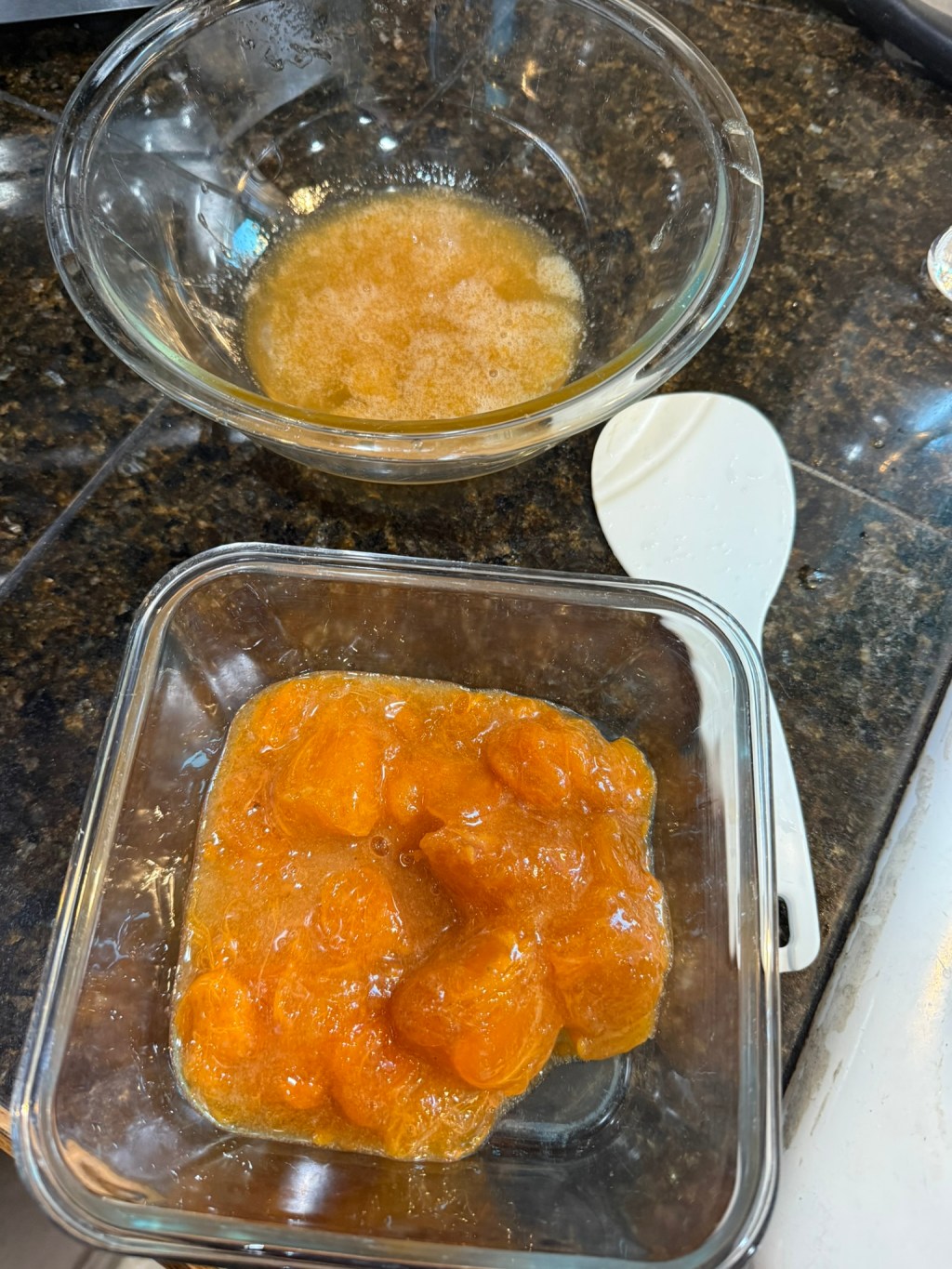
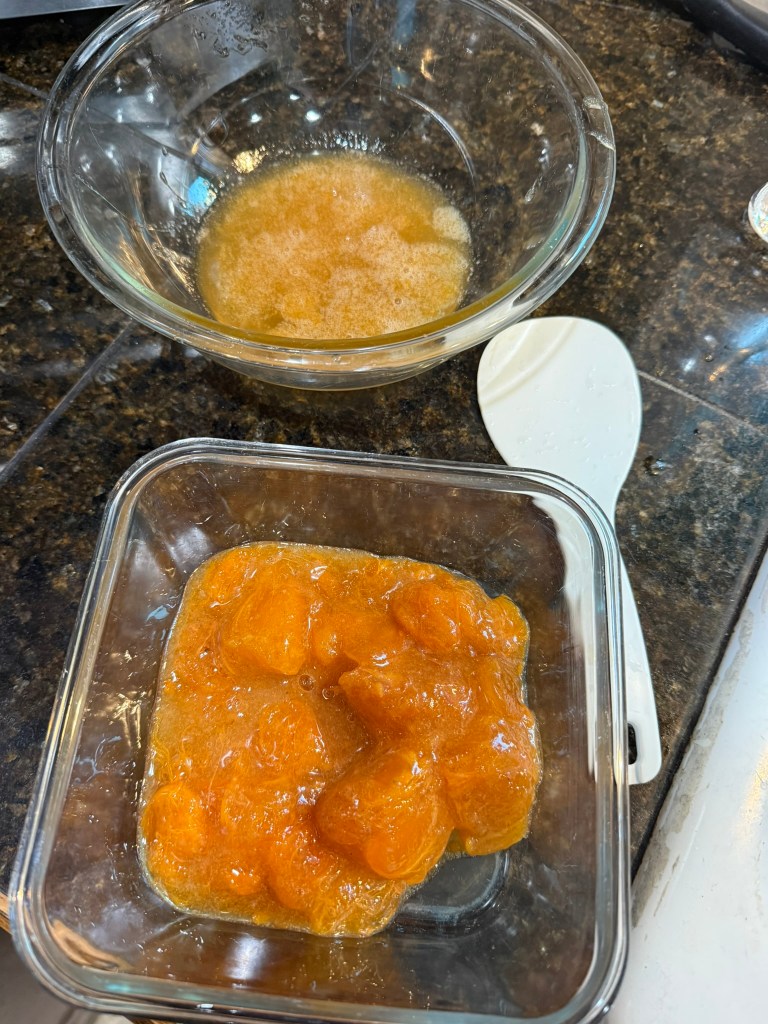
The next morning—at approximately 6:40 a.m., for reasons I still cannot explain—I strained out the solids and was left with about 2 ounces of syrup.
This will be great in yogurt or something later.
The solids weren’t wasted. I saved them in a separate container with plans to add them to yogurt later.
Next came the vinegar.
I chose apple cider vinegar because I thought it would pair nicely with the sweetness of the persimmons. Most shrub recipes call for a 1:1 ratio of syrup to vinegar, but since this was my first attempt, I approached it cautiously.
After all, you can always add more vinegar.
You cannot un-vinegar something.
I started at about 50% of the recommended amount and gradually worked my way up to around 75%, tasting as I went.
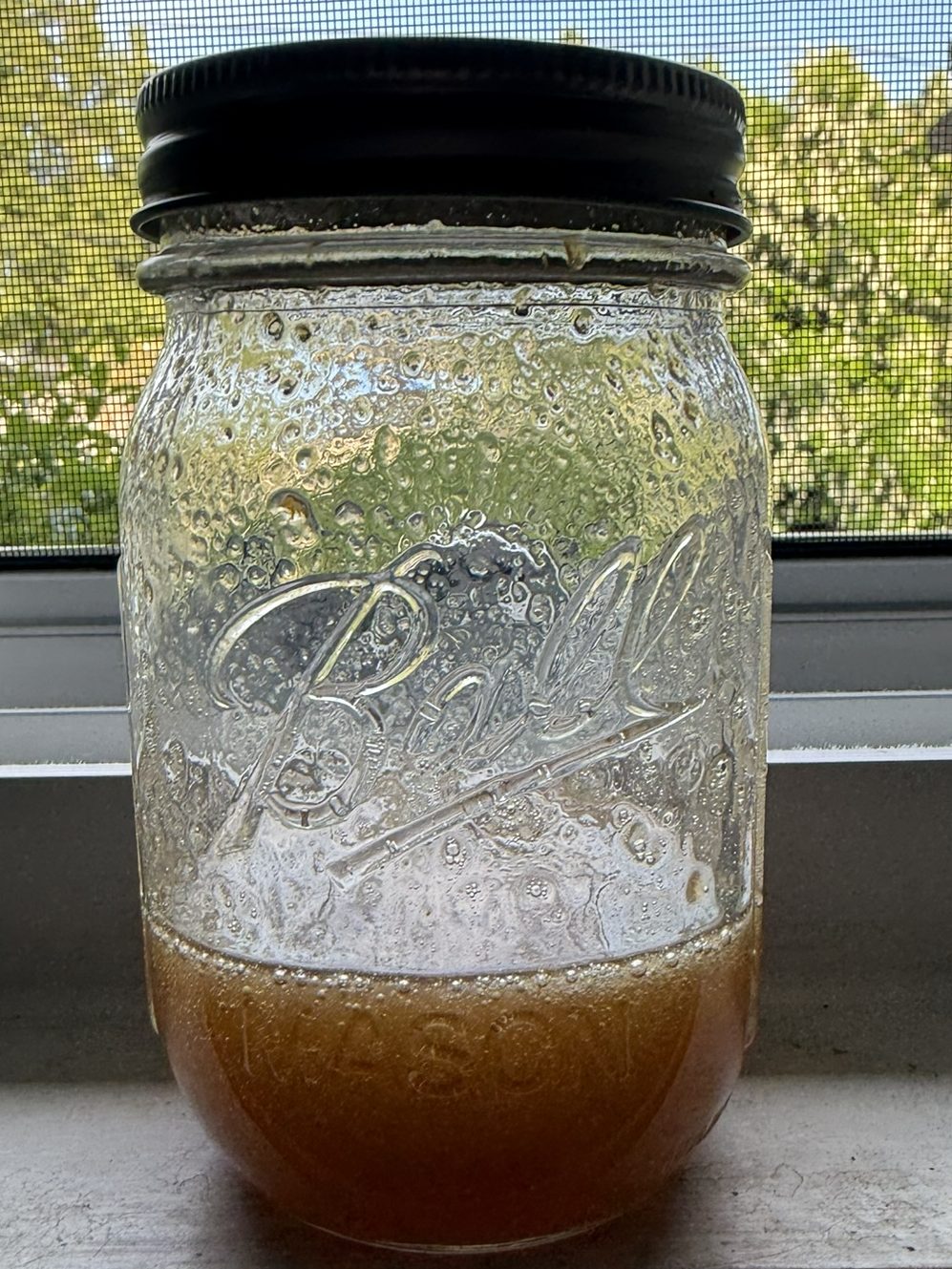
Once I was happy with the balance, I transferred everything to a mason jar and gave it a good shake.
Then I tasted it.
Wow.
This is going to be good.
At least this wasn’t days of work to only get 4 ounces.
At the time of writing, I haven’t actually used it in a drink yet. I want to give the flavors another day or two to mingle before I start experimenting.
Besides, I only ended up with about 4 ounces of shrub.
If it’s as good as I think it’s going to be, I need to exercise at least a little self-control.