A while ago, I wrote about why I think people misunderstand what Duolingo is actually good for. Apparently, I needed to start learning a fictional language to prove my own point.
Three High Valyrian lessons in, Duolingo has already taught me two grammar rules without ever explicitly teaching me either of them.
I wasn’t going to try learning this fictional language, since I am already learning two that don’t have a lot of native speakers (especially Gàidhlig). But I also don’t like to rely on captions to give me the correct translation. Hence the original reason for learning Gàidhlig: not trusting Outlander to tell me what that sneaky Dougal was communicating.
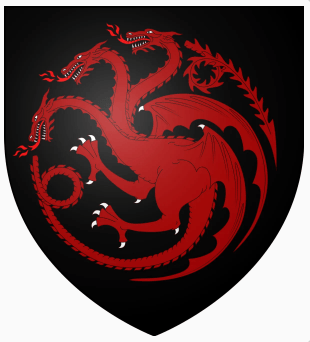
Last night, we were watching House of the Dragon when the characters started speaking High Valyrian.
My spouse asked, “How much of that did you understand?”
“I’ve only had two lessons.”
“Yeah, I know.”
Fair.
But two lessons had already been enough for me to start noticing patterns. I figured out that vala (man) becomes valar (men) when it changes from singular to plural. Then today, I encountered vali. Same noun, different ending—and this time, the change wasn’t about how many men there were. It was about the noun’s role in the sentence.
Duolingo hadn’t stopped to explain either change to me. I figured them out by seeing the words used in context.
I’ve never truly studied Latin. After taking years of French, the addition of declensions made my brain hurt, and I really should have learned Latin first so that French was easier. Lesson learned, I guess.
High Valyrian seems to have a lot of declensions as well. So I will be writing down everything I can about word order, noun and verb endings, and whatever other patterns I start to notice.
This whole endeavor reminds me of taking the DLAB (Defense Language Aptitude Battery) when I served. I only needed to score 100 to be able to study one of the more difficult languages, like Arabic or Mandarin. I ended up scoring a 137, but unfortunately, the recruiter I spoke with said I could reenlist “open contract” instead of promising me a job as an interpreter or translator.
Nope.
So I opted out.
At any rate, the DLAB was a super fun test. It had two parts. In the first, you basically filled in words in a comic book using context clues from a made-up language. After that came a listening section, where you were given one grammar rule at a time, then listened to something and had to figure out the correct translation.
There were seven total grammar rules, and they were cumulative. By the time you got to number seven, you’d best remember the six that came before it.
Thus, learning a fictional language like High Valyrian isn’t entirely new to me.
As I was gardening this morning, I finally made the connection between what I’m doing with High Valyrian and how much I loved taking the DLAB (nerd alert). I’m being given unfamiliar words, seeing and hearing them in different contexts, and figuring out the rules from the patterns.
Which brings me right back to Duolingo.
One of the complaints I see about Duolingo is that it doesn’t explicitly teach enough grammar. And that’s true: it often doesn’t sit you down, explain the rule, and then ask you to practice it.
But that doesn’t mean you aren’t learning grammar.
Sometimes it gives you enough examples that your brain starts asking, “Wait. Why did that word change?”
And then you see it again.
And eventually: Oh.
There’s the rule.
Three lessons into High Valyrian, I’ve already had that happen twice.
Apparently, give me a made-up language and some context clues, and my brain is perfectly happy to do the rest.
 Cèilidh Nam Freumhan