Category: Uncategorized

  • Too Many Interests, Not Enough Lifetimes

    Too Many Interests, Not Enough Lifetimes

    woman writing in a book while holding knitting needles with a water canner next to her.
    This is not an actual photo of me – credit to ChatGPT for the image generation.

    I have spent years feeling inadequate because there is so much I want to learn that I eventually become overwhelmed and end up touching none of it.

    At the moment, I am studying four languages. I am still in the phase where my brain immediately reverts to French because it was the first language I learned outside of English.

    There are currently four commonplace books in my bag. One of them is completely blank, just in case.

    I carry a pen case full of stationery tools I “might need,” along with a Kindle Scribe.

    I want to write a dissertation on the Scottish Highlands around the time of Culloden. Or perhaps another period of Highland history. I still cannot decide.

    I want to learn to knit so I can make beautiful sweaters and shawls.

    I am trying to grow my own food and learn how to can it, partially because gardening fascinates me and partially because apparently some part of my brain is preparing for a zombie apocalypse.

    I want to make paper and ink.

    I am going to spin my own yarn someday and dye it using plants I have grown myself.

    I am designing a planner that actually fits the way I think and work instead of settling for something mass-produced.

    I am binding notebooks by hand because it turns out I genuinely enjoy it.

    For a long time, all of this made me feel like a failure. I constantly felt behind. Surely, if I were more disciplined, more focused, or more organized, I would already be proficient at half these things.

    Eventually, though, I realized something important:

    You cannot dedicate your entire life to mastering dozens of subjects simultaneously.

    Some seasons of life are for language learning. Some are for gardening. Some are for theology, history, sewing, bookbinding, or note-taking systems.

    Some days I spend hours studying Torah. Other days I spend six straight hours documenting Norwegian vocabulary and grammar rules in my learning compendium like a Victorian scholar who has just discovered Scandinavia.

    And honestly? That is fine.

    I have stopped trying to force myself into becoming a hyper-efficient machine optimized for productivity and mastery at all times.

    Now I mostly try to ride the wave of whatever is currently lighting up my brain.

    The interests eventually circle back around anyway.

    You do not have to learn everything at once.

    You just have to stay curious enough to keep returning to the things you love.
  • Why Duolingo Frustrates Me as a Grammar Learner and Why I Still Think it Helps

    Why Duolingo Frustrates Me as a Grammar Learner and Why I Still Think it Helps

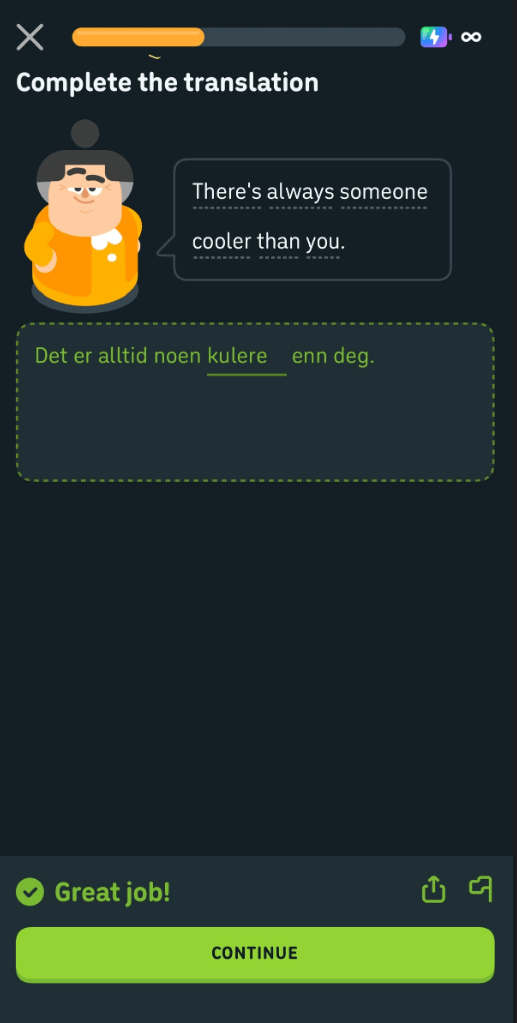
    I have an aptitude for languages, but I’ve always struggled with how they’re taught. Most resources either focus on memorizing phrases or bury you in grammar explanations before you can actually use anything. Duolingo sits somewhere in the middle – it gives you enough exposure to start seeing patterns, but not enough explanation to confirm what you’re noticing.

    That’s where the frustration starts.

    I’ll recognize a structure, test it across a few sentences, and start forming a rule in my head. Instead of confirming it, Duolingo just moves onto the next exercise. The hints are often too simplified or even wrong, which makes it worse – I’m not just confused, I’m second-guessing something I already noticed.

    And yet, I keep using it.

    One of the other methods I use for learning languages is listening to podcasts in that language, like something from NRK (Norwegian news and whatnot). Because of Duolingo, I have picked up on vocabulary that I normally wouldn’t have learned in a textbook until much later in my studies. So it does have its purpose. I wish you could take yourself out of the “league” competitions, since I don’t treat it as a game, but you have to have a public profile to have friends; that’s a nice feature because you can root each other on. However, I can do without Eddy yelling YOU’RE READY FOR HARD MODE WOOOOOOOO but it’s a minor inconvenience in the grand scheme of things.

    When learning a new language, you have to use multiple sources. You cannot depend on one particular app/book/whatever to get you to any kind of fluency. Speaking to a native is the best way to achieve your goals, but it can be hard to find a native speaker. If that is the case for you, just read out loud. Practice simple conversations with yourself so your mouth “remembers” what shape to form when you speak. The other day, I had a conversation in my head where I taught someone the French “-er” verb endings in Norwegian. Fun exercise!

    Duolingo isn’t perfect. The hints are questionable, the grammar is mostly implied, and Eddy is still yelling at me. But it’s useful in ways I didn’t expect – it gives me just enough input to start figuring things out for myself.

    And maybe that’s the point.

    It’s not the whole system. It’s just one part of it. And as long as I remember that, I’ll probably keep using it – whether I’m ready for hard mode or not.