Category: Learning & Study Journey

  • I Like Knowing Things

    I Like Knowing Things

    One of the things I’ve realized this year is that I don’t really collect hobbies.

    From the outside, it probably looks like I bounce from one thing to another. Gardening. Bookbinding. Norwegian. Citation templates. Herbs. Cocktails. Ancient history.

    They’re all over the place.

    To me, though, they’re all the same hobby.

    I like understanding how things work.

    The garden has made that clearer than anything else. Before this year, companion planting was something I’d read about. Soil composition was something I’d heard people discuss. Medicinal herbs were mostly names in books.

    Now I get to watch it happen.

    I’m seeing why one bed dries out faster than another. Why some plants seem happier next to certain neighbors. Which herbs attract pollinators and which ones don’t. Which vegetables struggle through a heat wave while others barely notice. It’s no longer just biology in a textbook. It’s biology happening in my backyard.

    That’s probably why my garden is organized the way it is. It isn’t the most efficient layout, and I’ve certainly spent more time weeding because of it. But separating plants by water needs, companion planting, shade, and other variables lets me see what works and what doesn’t. I’m treating the garden as one giant experiment.

    The same thing happens with my other projects.

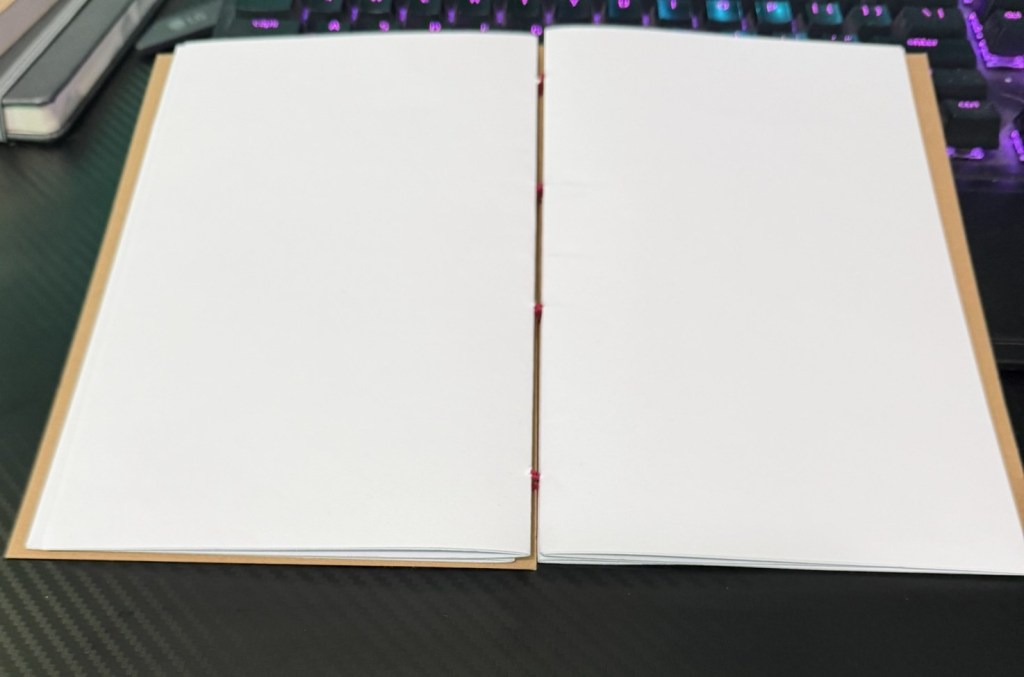
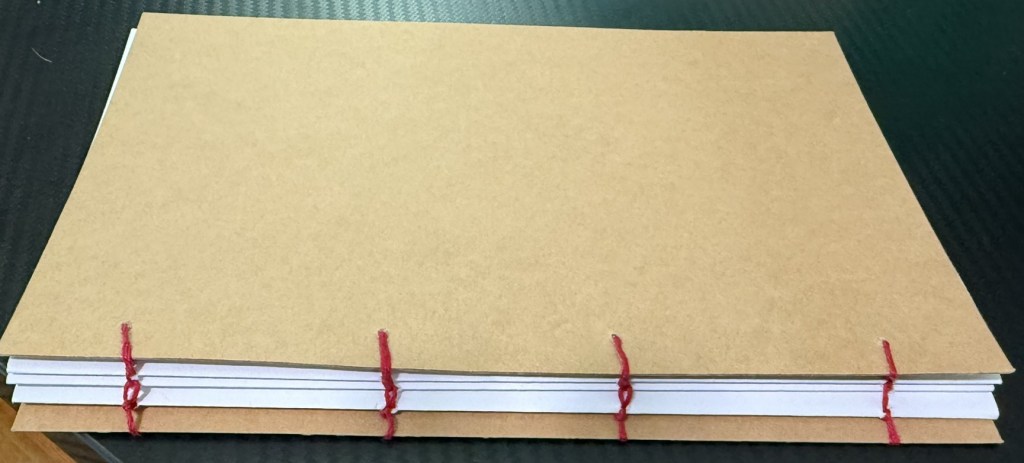
    I didn’t start making notebooks because I thought notebooks were too expensive. I started because I wanted to understand how books are made. Every mistake teaches me something, and every notebook gets a little better than the last.

    I originally started learning Norwegian because I had a reason to. Somewhere along the way, though, the language became the reward. I enjoy the grammar, I enjoy listening to it, and I was ridiculously proud of myself for using it in Oslo, even if it was only a little.

    The citation bundles might be the clearest example of all. I don’t enjoy formatting bibliographies. I enjoy solving problems, and I kept thinking about how much easier graduate school would have been if I’d had something like this on my desk.

    Maybe that’s why all of these projects seem connected to me, even if they don’t to anyone else.

    I’m not really collecting hobbies.

    I’m collecting understanding.

    woman surrounded by books and studying on her bed
    Photo by MART PRODUCTION on Pexels.com
  • How Many Notebooks is too Many?

    How Many Notebooks is too Many?

    I first learned about commonplace books while reading the second book of A Discovery of Witches. It sounded like such a cool idea.

    I immediately found an unused notebook in my inventory and started carrying it around.

    I had been told that one simply writes down anything interesting. Unfortunately, I wasn’t finding anything interesting at first, and every time I wrote something down, it felt forced.

    A few months ago—maybe a year, time has ceased to have meaning—I started a bullet journal again. Instead of writing down things I needed to do or making trackers, it slowly turned into a commonplace book.

    I started devoting entire sections to things I was interested in: four pages on whisky, seven pages on Gàidhlig grammar, and assorted bits of trivia that appealed to me for reasons known only to my brain.

    Eventually, I had to start making separate notebooks. I simply had too many interests to fit into one.

    As far as I can remember, I currently have notebooks for:

    • Baseball
    • Gàidhlig
    • Norwegian
    • One for a game I am playing but refuse to admit to publicly
    • Religious studies
    • Gardening adventures (which covers enough topics to qualify as several notebooks by itself)

    And I still have many blank notebooks waiting to be filled.

    So how many notebooks is too many?

    Like the question of how many licks it takes to get to the center of a Tootsie Pop, the world may never know.

    Photo by cottonbro studio on Pexels.com
  • Middle Age is Realizing You Can Just Learn Weird Things

    Middle Age is Realizing You Can Just Learn Weird Things

    I think a lot of us are taught that life follows a fairly straightforward path: go to college right after high school, find a career, and work forty or more hours a week until retirement. I never really followed that plan, and for a long time I felt like I had somehow done life incorrectly.

    As I have gotten older, though, I have realized that the things I didn’t do made me different in a way that I actually appreciate. I have always been curious, and I finally feel like I have given myself permission to simply learn things because they interest me.

    So these days I find myself learning crafts, bookbinding, languages, gardening, and even some homesteading skills. There is always some new rabbit hole waiting to be explored.

    Not always having steady work has certainly been stressful, but it has also taught me that life is about more than giving decades of yourself to an employer who may never appreciate you the way you deserve. There is value in creating things, learning things, and following your curiosity.

    At this point, if something sounds interesting, I want to try it. Some people may think that is strange, and perhaps it is. But I enjoy it, and I like the idea of keeping my mind active and open to new experiences.

    Maybe I am making up for lost time. Or maybe I am finally becoming the person I was always meant to be.

    Either way, I think Hannah Montana had it right:

    “Life’s what you make it.”

    Photo by Paweu0142 L. on Pexels.com
  • The Case for Overcomplicating Things

    The Case for Overcomplicating Things

    I have a tendency to overcomplicate things. At least, that is probably how it appears from the outside. But for me, I usually have to do things the “hard way” if I want them to work at all.

    For example, I grouped my garden into separate beds based on companion planting, water needs, shade requirements, and a variety of other factors. That left a lot of space in between them that still isn’t completely weeded and is taking a massive amount of time.

    But all of that was necessary if I wanted to see what works and what doesn’t. I already know that I can’t plant anything close to the quince-from-hell, and that apparently I can kill peppermint where I intentionally planted it, but not the peppermint that insists on growing literally everywhere else in the garden.

    I have notebooks for language learning. I keep lists of cocktail ideas. I have spent an unreasonable amount of time designing printables. I make tables, draw diagrams, and write down things that many people would simply trust themselves to remember.

    I don’t think the complexity is the problem. I think it is how I learn.

    I need to do things in a way that helps me not only learn, but remember what I learned and how I learned it.

    Paying attention applies to just about everything I do instead of blindly hoping for success.

    I have always felt the need to break things down and figure out how they work. I have never been able to simply memorize phrases and words in other languages because I need to know why something is spelled one way with one pronoun and differently when the pronoun changes.

    I enjoy creating systems. I love finding patterns. That might mean I have more notebooks than most people find necessary.

    Some days I will spend hours writing down Norwegian grammar rules and lists of reflexive verbs. Other days I will spend hours drawing diagrams of different baseball pitches.

    What looks complicated to others simply feels interesting to me.

    The goal was never perfection.

    It was understanding.

    And if understanding occasionally requires a little overcomplication, I think that’s a trade-off worth making.

    Mass communication complicated issues Karl by libraryofcongress is licensed under CC-CC0 1.0
  • Building a Language Compendium

    Building a Language Compendium

    I hit Norwegian hard before my trip and ultimately got burned out. One thing that came out of it, though, was an idea I really liked: a language-learning compendium.

    Obviously, I started with basics like articles, gender, common verbs, and conjugations. But I also wanted to add things that I knew would help me personally.

    For example, I struggle with vocabulary recall, especially when I’m nervous. What I ended up doing was asking ChatGPT to give me short readings at my current level. I would write down words I didn’t know, look up their meanings, and add them to the compendium. Writing them down helps force them to stick in my memory.

    I write everything in pencil first, then go back over it in pen. Studies have shown that handwriting notes helps retention, and after years of trying different methods, I know that writing things down works better for me than typing.

    Right now, I am diving deeper into grammar, like modal verbs, and writing down common phrases and usage notes. I still burn out from time to time, but I am really enjoying the process.

    I am also not sure why I am studying so hard, since I keep second-guessing whether I will ever be able to move to Oslo.

    But I know myself.

    I just can’t stop learning.

    Even if other people think what I’m learning is useless.

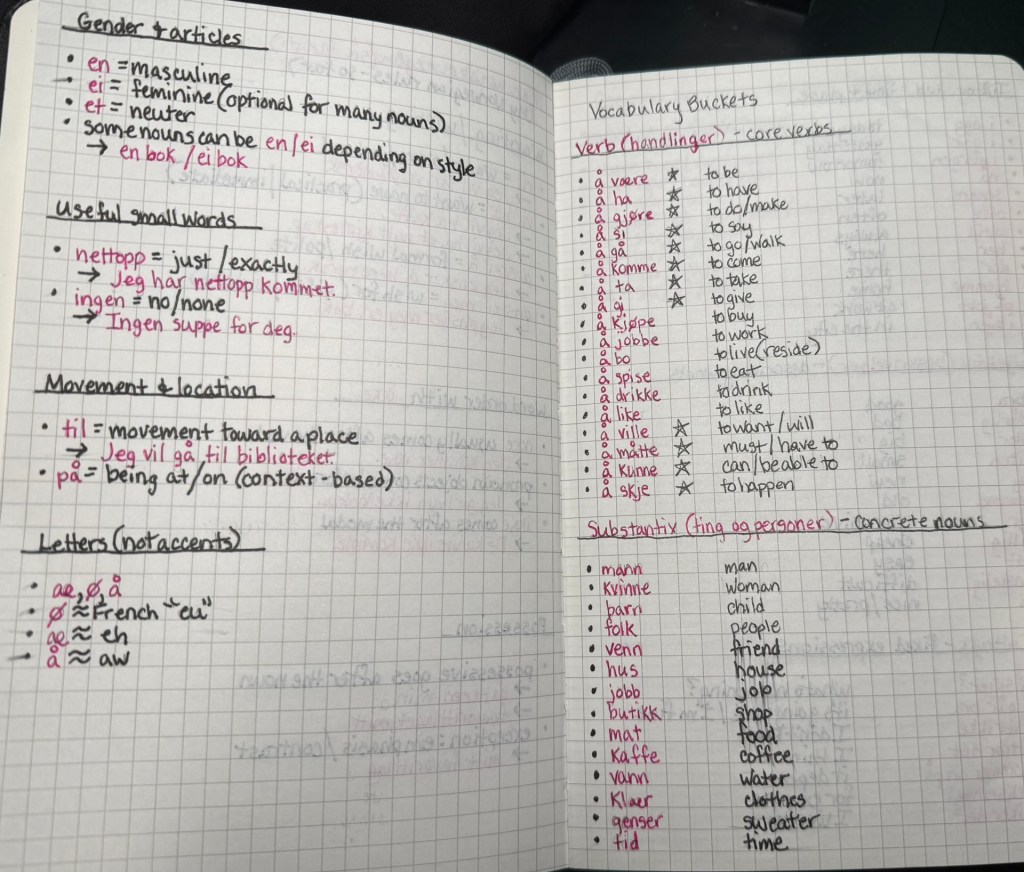
    book open to basic Norwegian grammar rules
    Basic grammar rules and commonly used verbs.
  • The Night They Put Lime in My Sazerac

    The Night They Put Lime in My Sazerac

    A few years ago, I decided to start making my own cocktails at home.

    There were several reasons for this. First, paying $15 for a cocktail is ridiculous. Second, too many bars serve inconsistent drinks. And third, there is nothing more disappointing than ordering a favorite cocktail and getting something completely out of balance.

    The final push came on my birthday.

    My spouse and I visited a local speakeasy that I had enjoyed before. It was a charming place: Prohibition-era cocktails, a small intimate room, and a password required to get through the door. Unfortunately, this visit was memorable for all the wrong reasons.

    My spouse asked the bartender a question about one of the top-shelf bourbons. The bartender pulled the bottle down and slammed it onto the bar without saying a word. From that point forward, things only got worse. Our cocktails arrived in the wrong glassware, and they weren’t made correctly. At one point, my Sazerac arrived with lime in it.

    A Sazerac.

    With lime.

    Some crimes cannot be forgiven.

    On the way home, we stopped at a liquor store. I bought a few bottles and decided that if I wanted a proper Sazerac, I was going to learn how to make one myself.

    It turned out to be one of the better decisions I’ve made.

    Around that same time, I had watched far too many episodes of Bar Rescue. For all its drama, the show taught me something important: balance matters. A bartender who pours extra liquor into your drink isn’t necessarily doing you a favor. Every ingredient is there for a reason. The goal is not to taste the alcohol; the goal is to create something where the ingredients work together.

    The more I learned, the more I noticed inconsistencies when I went out. At one upscale restaurant in town, I watched a bartender make two copies of the same specialty cocktail. They came out noticeably different shades of green. That should never happen. A cocktail should look and taste the same every single time.

    These days, I have a growing collection of bar tools: jiggers, pour spouts, bar spoons, mixing glasses, strainers, and pretty much everything else a home bartender could want.

    And before anyone says it: a pony is not a jigger.

    A pony measures 1 ounce and 1/2 ounce. A jigger measures 2 ounces and 1 ounce. I will die on this hill.

    I use those tools, too. Every pour gets measured. Every recipe gets followed. Consistency matters.

    For what it’s worth, I make a heck of a Sazerac.

    Historical reenactment.
  • Too Many Interests, Not Enough Lifetimes

    Too Many Interests, Not Enough Lifetimes

    woman writing in a book while holding knitting needles with a water canner next to her.
    This is not an actual photo of me – credit to ChatGPT for the image generation.

    I have spent years feeling inadequate because there is so much I want to learn that I eventually become overwhelmed and end up touching none of it.

    At the moment, I am studying four languages. I am still in the phase where my brain immediately reverts to French because it was the first language I learned outside of English.

    There are currently four commonplace books in my bag. One of them is completely blank, just in case.

    I carry a pen case full of stationery tools I “might need,” along with a Kindle Scribe.

    I want to write a dissertation on the Scottish Highlands around the time of Culloden. Or perhaps another period of Highland history. I still cannot decide.

    I want to learn to knit so I can make beautiful sweaters and shawls.

    I am trying to grow my own food and learn how to can it, partially because gardening fascinates me and partially because apparently some part of my brain is preparing for a zombie apocalypse.

    I want to make paper and ink.

    I am going to spin my own yarn someday and dye it using plants I have grown myself.

    I am designing a planner that actually fits the way I think and work instead of settling for something mass-produced.

    I am binding notebooks by hand because it turns out I genuinely enjoy it.

    For a long time, all of this made me feel like a failure. I constantly felt behind. Surely, if I were more disciplined, more focused, or more organized, I would already be proficient at half these things.

    Eventually, though, I realized something important:

    You cannot dedicate your entire life to mastering dozens of subjects simultaneously.

    Some seasons of life are for language learning. Some are for gardening. Some are for theology, history, sewing, bookbinding, or note-taking systems.

    Some days I spend hours studying Torah. Other days I spend six straight hours documenting Norwegian vocabulary and grammar rules in my learning compendium like a Victorian scholar who has just discovered Scandinavia.

    And honestly? That is fine.

    I have stopped trying to force myself into becoming a hyper-efficient machine optimized for productivity and mastery at all times.

    Now I mostly try to ride the wave of whatever is currently lighting up my brain.

    The interests eventually circle back around anyway.

    You do not have to learn everything at once.

    You just have to stay curious enough to keep returning to the things you love.

  • I Never Learned How to Study

    I Never Learned How to Study

    planner, coffee, pen, phone laid out on table
    Notebook phone table by Markus Spiske is licensed under CC-CC0 1.0

    There have been several studies showing that people tend to remember information better when they write it down by hand. For me, that has absolutely been true. Hence the ever-growing stack of commonplace books around my house.

    One study discussed in Scientific American explains that typing involves repeating the same simple finger movements, while handwriting creates distinct physical motions for each letter. According to Audrey van der Meer, who spearheaded the study, handwriting helps lock the motor and sensory systems together.

    I won’t get too deep into the science here. That isn’t my area of expertise. But looking back, I wish I had been able to handwrite more of my notes in law school.

    I tried for a week or two. Eventually, though, the professors spoke too quickly for me to keep up effectively by hand. I switched to typing instead, organizing everything neatly in OneNote by class, with individual pages for each topic on the syllabus. My organization system was solid. The problem was retention.

    I’m also not the type of person who can compulsively reread notes over and over again. That makes it especially important for me to absorb the material the first time I encounter it, and handwriting seems to help with that.

    In high school, we had spelling tests where we memorized vocabulary terms alongside their definitions. During the test, we had to fill in the correct word next to each definition. Because I had physically written the words down beforehand, I could often close my eyes and “see” the page in my head. Even if I couldn’t immediately remember the correct word, I could remember where it had been positioned relative to the others on the list.

    That kind of visual and physical memory still seems to matter for me now.

    At any rate, I love creating these various and often random commonplace books. I don’t have to learn at someone else’s speed. I can sketch diagrams where needed. I can reorganize information however my brain naturally wants to process it. For me, it’s simply a better system.

    The funny thing is that I never really learned how to study. As a child, most schoolwork came easily to me, so no one ever thought I might need actual study strategies later on.

    Over the years, I have Googled and browsed Pinterest trying to find the “best” note-taking system. One method that appears constantly is the Cornell Method, where the page is divided into three sections: a narrow left-hand “cue” column for keywords or questions, a larger note-taking section on the right, and a summary section at the bottom.

    I tried it a couple of times and never found it especially helpful. Even the research surrounding the method seems somewhat inconclusive.

    What I eventually realized is that I don’t need an elaborate system.

    I just need something straightforward that works with the way my brain already processes information: plain notebooks, handwritten notes, and room to think.

    No fancy handwriting. No planner stickers. Just paper.

    And yes, I once asked ChatGPT for note-taking advice. It suggested mind maps.

    I practically yelled at the screen.

    They look so chaotic to me that I know I would immediately become irritated with my own notes and never look at them again.

    example of a mind map
  • What I’m Bringing (and Not Bringing) to Read on Vacation

    What I’m Bringing (and Not Bringing) to Read on Vacation

    Every time I take a vacation (which is rare the past few years), I always end up being overly ambitious about how many books I will get through. Even though I always have my Kindle, I still think I should pack 3 or 4 physical books too.

    I considered taking two physical books and one commonplace book for this trip and studying a bit. Then I remembered that ships sway. Like…a lot. I try very hard to keep my handwriting neat and readable, so I don’t believe a swaying ship will be conducive in this particular endeavor.

    Thus, I will only take my Kindle. I have the Scribe, which comes with a stylus, so I can either take notes in the book itself, or highlight things I might want to transfer into a commonplace book after I get home.

    I am also one of those people who packs a ton of stuff “just in case” I want to use it. For example, when I go to work, my bag contains my Kindle; a pen case with a variety of Zebra Mildliners, some washi tape, correction tape, a straightedge, two mechanical pencils, lead refills, and an eraser; at least two of my commonplace books; my planner (which is in its own purse); and if there is a morning/early afternoon baseball game, my tablet. Yesterday, I was excited to read during lunch, so guess what I forgot to pack? See? If I don’t have it, that’s the only thing I want.

    So…I have to be firm while packing. Kindle, planner, maybe one commonplace book. Oh, and I suppose I should pack clothes.

    Stacks of black notebooks on a table with evergreen holiday decorations by Courtney Robertson is licensed under CC-CC0 1.0
  • Trying to find Jewish learning resources (and not ending up with a sermon about a donkey)

    Today I ventured into WordPress Reader, hoping to find a neat blog about Torah study, Talmud, Midrash, Rashi, Rambam… etc.

    So I started with the basic search: “Torah study.”

    Everything I got was either Christian commentary, or a Messianic blog that doesn’t really align with what I’m looking for.

    So… I tried Rambam, then Rashi, and somehow ended up with several Hindu websites. Baffling.

    Next, I thought maybe “Maimonides” would get me what I wanted. Nope! I got one hit for a dental society and another for a mental health center.

    “Talmud.” That brought up a blog post about how Jews and Muslims view Jesus. I scrolled a little further and got a post about Jesus riding a donkey into Jerusalem.

    jesus on a donkey
    This is when I knew I was in the wrong place.

    “Midrash.” A commentary on the Bible through a “womanist lens.”

    At that point, I had to give up. I don’t think WordPress Reader is going to get me the content I’m actually looking for, so I’m heading back to the Jewish learning websites I already know.

    Oh… and “Six Degrees of Kosher Bacon” was an interesting title, but I’m not sure that’s for me either. I am a vegan, after all. 😉

    Note: This post isn’t meant to criticize anyone’s beliefs—it’s just me being frustrated that clearly Jewish search terms don’t always return Jewish-focused results.